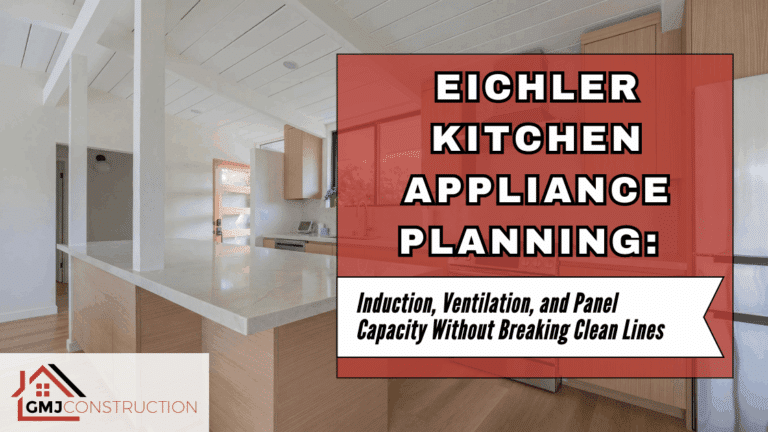
An Eichler kitchen should feel open, calm, and connected to the rest of the home, even when it contains modern appliances and upgraded electrical systems. Achieving that balance requires more than choosing attractive finishes.
Your appliance specifications can affect cabinet dimensions, ventilation routes, electrical capacity, countertop fabrication, and the visibility of architectural details. Resources from the U.S. Department of Energy on induction cooking can help you understand the technology, but the appliance must still be evaluated within the context of your particular home. Before moving forward with an Eichler kitchen remodel, coordinate the appliance, cabinet, electrical, and ventilation plans into a single system.
Why Appliance Planning Matters in an Eichler Kitchen Remodel
Eichler kitchen appliance planning affects nearly every part of the project. A refrigerator influences cabinet depth and circulation. An induction cooktop may require a dedicated circuit. A powerful hood needs an appropriate duct route and may affect the ceiling, roof, or exterior wall.
These decisions are especially important in an open-plan Eichler kitchen, where the kitchen is often visible from the dining room, living area, atrium, or backyard. The goal is not simply to fit appliances into cabinets. It is to protect the proportions and uninterrupted lines that make the home distinctive.
Select preliminary appliances before approving cabinet drawings, countertops, electrical plans, or ventilation routes. This early coordination is one of the most important principles when renovating an Eichler home.
Start With the Kitchen Layout and Eichler’s Architectural Lines
Identify the Original Kitchen Footprint and Sightlines
Begin by documenting the existing Eichler kitchen layout, including circulation paths, exposed beams, ceiling boards, glass walls, exterior doors, and connections to adjacent rooms.
Stand at the home’s primary entrances and living areas. Notice which parts of the kitchen are most visible. Tall appliances, oversized hoods, and deep cabinets should not interrupt important sightlines or make the room feel enclosed. GMJ Construction’s guide to mid-century kitchen layout rules for Eichlers provides additional guidance on flow, work zones, and openness.
Decide Which Appliances Should Be Visible, Integrated, or Concealed
Not every appliance needs to disappear. A simple stainless steel range may complement the room, while a large refrigerator may be better integrated behind cabinet panels.
Classify each appliance as:
- A visible design feature
- A visually neutral appliance
- A panel-ready or concealed appliance
- A small appliance that needs dedicated storage
This prevents you from spending heavily to conceal everything while overlooking the appliances that create the most visual clutter.
Measure Appliances Before Finalizing Cabinetry
Manufacturer-listed width is only the starting point. Record the full appliance dimensions and required installation conditions, including:
- Handles and projecting controls
- Door and drawer swings
- Ventilation clearances
- Countertop depth
- Electrical or plumbing connection space
- Installation and removal access
- Adjacent wall and cabinet clearances
A refrigerator door that cannot open fully or an oven handle that narrows a walkway can undermine an otherwise thoughtful plan. Coordinate these measurements with your Eichler kitchen cabinet design before fabrication begins.
Is Induction Cooking a Good Fit for an Eichler Kitchen?
Benefits of Induction for a Clean, Modern Kitchen
An induction cooktop can work well with mid-century modern kitchen design because it creates a smooth, visually quiet cooking surface. Flush or nearly flush installation can reduce visual clutter, particularly when the cooktop is placed in a long countertop run or minimalist island.
Induction also provides responsive temperature control and a surface that is generally easier to wipe clean than exposed burners. However, the final installation must follow the appliance manufacturer’s countertop, cabinet, ventilation, and electrical requirements.
Induction Range vs. Separate Cooktop and Wall Oven
An induction range combines the cooktop and oven into one appliance. It can simplify the layout, reduce cabinet modifications, and preserve a familiar cooking arrangement.
A separate cooktop and wall oven offer greater placement flexibility. The oven can be installed at a comfortable height or incorporated into a tall appliance bank. However, separate appliances often require additional circuits, cabinetry, coordination, and installation space.
Compare the options based on:
- Available wall and cabinet space
- Desired oven height
- Number and size of ovens
- Electrical requirements
- Sightlines from adjoining rooms
- Cabinet and countertop complexity
Check Cookware and Daily Cooking Habits
Induction requires compatible magnetic cookware. Test existing pots and pans with a magnet. If the magnet attaches firmly to the bottom, the cookware will generally work, although the appliance manufacturer should provide the final compatibility guidance.
Consider how you cook as well. Burner spacing, control placement, bridge elements, pan sizes, and oven configuration may matter more than appearance alone.
Plan the Electrical Requirements Before Installation
Do not assume a new induction range or cooktop can use the existing circuit. Confirm the appliance’s voltage, amperage, breaker, conductor, disconnect, and installation requirements with a qualified electrician.
The electrician should also evaluate the wiring pathway from the panel to the kitchen. In an Eichler, routing new wiring may require special planning to avoid unnecessary disturbance to exposed ceilings, slab systems, and other original materials.
Ventilation Options That Protect the Open Eichler Floor Plan
Why Ventilation Matters Even With Induction
Induction eliminates combustion at the cooktop, but it does not eliminate smoke, grease, steam, moisture, odors, or particles produced by cooking. Effective kitchen exhaust planning remains important, particularly when the kitchen opens directly into living and dining spaces.
Whenever feasible and appropriate for the project, the exhaust system should capture cooking byproducts near the source and discharge them outdoors.
Choose Between a Wall Hood, Ceiling Hood, and Downdraft System
A wall-mounted hood typically provides direct capture above a cooking surface positioned against a wall. It can also become a strong visual feature, so its scale and finish should be carefully selected.
A ceiling-mounted or island hood preserves the placement of an island cooktop but may become visually prominent against an Eichler’s ceiling. A downdraft system can reduce overhead clutter, although its effectiveness depends heavily on the appliance, cooking conditions, duct route, and installation.
Evaluate each option based on performance, appearance, noise, ducting, maintenance, and compatibility with the kitchen layout.
Size the Ventilation System for the Cooking Surface
Range hood sizing should not be based on airflow alone. Review:
- Cooktop width and location
- Type and frequency of cooking
- Hood capture area
- Mounting height
- Duct diameter
- Duct length and number of turns
- Fan sound ratings
- Manufacturer requirements
A properly sized hood with a direct duct path may perform better than a higher-rated unit connected to restrictive ductwork.
Preserve Exposed Beams and Tongue-and-Groove Ceilings
Before cutting through original ceiling boards, explore alternative duct routes through an exterior wall, cabinet chase, soffit, utility area, or carefully selected roof location.
This same preservation-first approach is valuable when adding Eichler lighting without cutting tongue-and-groove ceilings. Any roof penetration must also be coordinated with the home’s flat-roof conditions and waterproofing details.
Plan Makeup Air and Exterior Vent Locations
High-capacity exhaust systems may require a source of replacement air under applicable codes. Requirements vary by jurisdiction, appliance capacity, home conditions, and adopted code provisions, so confirm them with the project team and local building department.
The exterior termination should also be located away from nearby openings and positioned to minimize its visual impact. Coordinate roof, wall, flashing, and weatherproofing details before construction.
Can the Existing Electrical Panel Support an All-Electric Kitchen?
Calculate the Kitchen’s Anticipated Electrical Load
An electrical load calculation should account for more than the induction appliance. Include the ovens, refrigerator, dishwasher, microwave, disposal, ventilation equipment, lighting, required countertop circuits, and other fixed appliances.
The California Energy Commission’s homeowner electrification resources explain why panel capacity should be evaluated before adding major electric equipment.
Understand Why Older Eichler Panels May Need Evaluation
An older electrical system may have limited capacity, few available breaker spaces, aging components, outdated grounding, or undocumented modifications. The panel label alone does not provide a complete picture.
A qualified electrician should inspect:
- Service and panel ratings
- Breaker condition and compatibility
- Available spaces
- Existing calculated load
- Wiring condition
- Grounding and bonding
- Prior additions or alterations
Read more about upgrading Eichler electrical panels and wiring for modern loads before finalizing an all-electric plan.
Determine Whether You Need a Panel Upgrade or Load Management
A larger electrical service is not the only possible solution. Depending on the home and project, the team may evaluate a panel replacement, subpanel, load-management equipment, appliance selection changes, or scheduling controls.
The correct approach depends on the calculated load, utility service, code requirements, installation conditions, and future plans. Do not purchase the final appliances until electrical feasibility has been confirmed.
Coordinate Future Electrical Needs
Think beyond the kitchen. You may eventually add an EV charger, heat-pump HVAC system, electric water heater, battery, solar equipment, room addition, or ADU.
Planning these loads together can reduce repeated electrical work and help you prioritize capacity. GMJ Construction’s guide to energy-efficient upgrades for Eichler homes can help you consider the kitchen within a larger home-electrification plan.
How to Integrate Appliances Without Breaking the Clean Lines
Use Panel-Ready Refrigeration and Dishwashers Strategically
Panel-ready appliances can create more continuous cabinetry, but the panels must comply with appliance weight, thickness, ventilation, hinge, and clearance requirements.
Align panel widths and reveals with the surrounding cabinet doors. At the same time, preserve access for appliance repair and eventual replacement.
Keep Tall Appliance Banks Away From Key Sightlines
Group refrigerators, wall ovens, pantry cabinets, and utility storage where they will not block glass walls or dominate the home’s primary living spaces.
Placing tall elements at the end of a cabinet run or against an existing solid wall can preserve a more open center. Review Eichler remodel before-and-after inspiration to study how cabinet massing changes the feeling of a room.
Align Appliances With Cabinet and Countertop Geometry
Coordinate appliance faces, cabinet fronts, countertop edges, toe kicks, handles, and control panels. Small inconsistencies become noticeable in a minimalist kitchen.
Before countertop fabrication, verify the exact cutout templates and installation requirements. This is particularly important when coordinating Eichler kitchen countertops and backsplashes with flush-mounted appliances.
Conceal Small Appliances Without Creating an Awkward Appliance Garage
Instead of placing a bulky appliance garage on the main counter, consider:
- Pocket-door pantry cabinets
- Lift-up cabinet doors
- Pullout shelves
- A dedicated beverage station
- A secondary counter inside a pantry zone
- Deep drawers for frequently used appliances
The best solution keeps appliances accessible without permanently occupying the visual foreground. Additional Eichler kitchen storage solutions can help organize small appliances and daily supplies.
Select Finishes That Complement Mid-Century Materials
Stainless steel, black glass, and integrated wood panels can all work in an Eichler kitchen. The key is restraint.
Choose a limited finish palette that complements flat-panel cabinetry, terrazzo, tile, wood ceilings, and natural surfaces. Avoid introducing too many competing metals, handle styles, screen finishes, or decorative details.
Coordinate Appliance, Cabinet, Electrical, and HVAC Plans Early
Create an Appliance Specification Schedule
Create one shared schedule listing each appliance’s:
- Manufacturer and model number
- Overall and cutout dimensions
- Electrical load
- Water, drain, or ventilation requirements
- Required clearances
- Door swing
- Panel specifications
- Installation documents
- Ordering status
Update the schedule whenever a model changes.
Confirm Rough-In Locations Before Cabinets Are Built
Verify every power, water, drain, duct, and data location before cabinet fabrication. Confirm whether connections must remain accessible and whether outlets or shutoffs will conflict with drawers, panels, or appliance bodies.
A field coordination review can catch errors that may not be obvious on a cabinet elevation.
Review the Plans With the Full Remodeling Team
The homeowner, designer, contractor, electrician, cabinetmaker, HVAC professional, countertop fabricator, and appliance installer should work from the same specifications.
A final coordination meeting should confirm the appliance models, rough-ins, ventilation route, panel strategy, clearances, cabinet dimensions, and installation responsibilities.
Common Eichler Kitchen Appliance Planning Mistakes to Avoid
Choosing Appliances After Cabinet Drawings Are Complete
Late appliance changes can alter cabinet openings, panel dimensions, countertops, outlets, ventilation, and walkways. Select preliminary models before cabinet drawings are approved.
Assuming an Induction Range Will Work With the Existing Panel
Never rely on breaker space alone. Complete the appropriate load evaluation and verify the circuit pathway before ordering the appliance.
Selecting a Downdraft System Based Only on Appearance
A downdraft may reduce overhead visual clutter, but performance, duct routing, cabinet space, and cooking habits should drive the decision.
Cutting Through Original Ceilings Without Exploring Other Duct Routes
Once original ceiling boards or beams are altered, repairs may remain visible. Investigate every practical duct and wiring route first.
Prioritizing Flush Installation Over Required Clearances
A flush appearance should never override manufacturer-required ventilation gaps, service access, combustible clearances, or door movement. Review the most common Eichler remodeling mistakes before approving final details.
Eichler Kitchen Appliance Planning Checklist
- Select preliminary appliance models before finalizing the kitchen layout.
- Record the dimensions and installation requirements for every appliance.
- Confirm induction circuit and total electrical load requirements.
- Have the existing panel and wiring evaluated.
- Select the ventilation type and map the complete duct route.
- Check whether makeup air may be required.
- Coordinate appliance panels with cabinet dimensions and reveals.
- Verify door swings, walkways, and service clearances.
- Review rough-in locations before cabinet fabrication.
- Complete a final coordination review before ordering appliances.
Plan an Eichler Kitchen That Performs Without Losing Its Character
Successful Eichler kitchen appliance planning brings the layout, induction system, ventilation, cabinetry, electrical capacity, and original architecture together before construction begins. Early decisions can help you preserve sightlines, avoid unnecessary ceiling cuts, maintain clean cabinet geometry, and prepare the home for future electrical needs.
Before ordering appliances or finalizing cabinets, consult a remodeling team that understands how modern systems interact with post-and-beam construction, exposed ceilings, open floor plans, and glass walls. GMJ Construction provides Eichler home remodeling services and kitchen planning for homeowners throughout communities such as Palo Alto, Los Altos, Sunnyvale, and San Jose.