
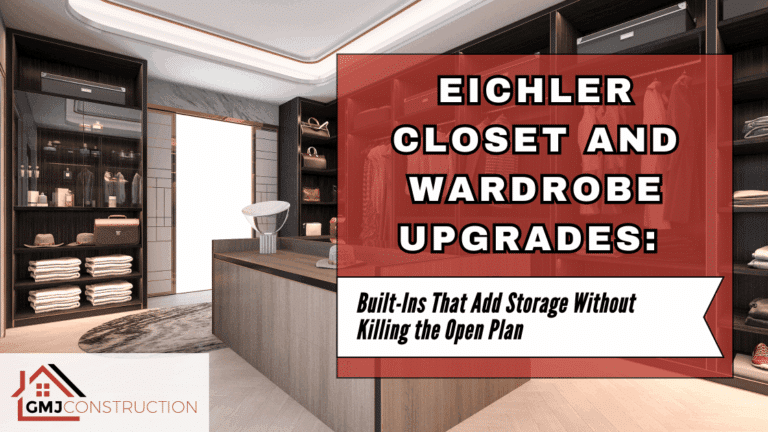
The best Eichler closet upgrades add capacity along existing visual boundaries, use simple wall-integrated cabinetry, and protect the sightlines, daylight, and circulation that make the home feel open. Rather than placing bulky furniture throughout the interior, treat new wardrobes as part of the architecture. Eichler homes commonly combine post-and-beam construction, concrete slab foundations, broad glazing, and flexible interior arrangements, as documented in the Palo Alto Eichler Neighborhood Design Guidelines. That combination creates opportunities for customized storage, but it also makes poor placement especially noticeable. Cabinet depth, door operation, finish sheen, utility locations, and surrounding light should all be resolved before fabrication. A thoughtful Eichler home remodeling plan can provide more storage without making the interior feel smaller, darker, or less authentic.
Why Standard Closet Solutions Often Feel Wrong in an Eichler
Many modular closet systems are designed to maximize cabinet volume without considering the architecture around them. In an Eichler, that approach can create three common conflicts:
- Blocked sightlines between connected rooms
- Cabinet details that compete with the home’s simplicity
- Reduced daylight near windows, clerestories, and atrium glazing
Bulky Cabinetry Can Interrupt the Open Plan
Deep wardrobes and freestanding storage towers can narrow circulation or visually divide spaces that were intended to flow together. Before placing a cabinet, study views from the entry, kitchen, living area, atrium, and major exterior doors.
The National Park Service’s interior rehabilitation guidance emphasizes the importance of a building’s spatial configuration, proportions, circulation, and relationships between rooms. This principle is especially relevant when planning storage in an open Eichler interior.
Traditional Cabinet Details Can Clash With Eichler Simplicity
Raised panels, ornate molding, decorative feet, heavy trim, and oversized handles can make a new wardrobe feel like furniture from another architectural style. Flat planes, narrow reveals, slab doors, and integrated pulls usually create a better visual relationship with an Eichler.
Homeowners should also be cautious with products marketed broadly as “mid-century modern.” A decorative retro appearance is not necessarily the same as an appropriate Eichler design. The recommendations in the dos and don’ts of Eichler remodeling provide a useful starting point for avoiding additions that overpower the original architecture.
Poor Placement Can Reduce Daylight and Indoor-Outdoor Connection
Tall cabinets should generally remain away from window walls, clerestories, atrium openings, and heavily used exterior doors. Even when cabinetry does not physically cover glass, its height and projection can change how daylight spreads through the room.
Evaluate the cabinet from multiple positions before approving the layout. Tape its proposed width and depth on the floor and wall, then observe it during morning and afternoon light.
Start With the Right Location for New Built-In Storage
The most successful Eichler built-in wardrobes usually occupy walls that already act as visual boundaries. This allows storage to improve function without creating a new obstruction.
Use this checklist when comparing locations:
- Identify solid walls, hallway ends, recesses, and underused transition areas.
- Mark important views, windows, doors, and circulation routes.
- Determine the depth required for the items being stored.
- Check nearby switches, outlets, vents, plumbing, and heating controls.
- Compare one continuous built-in with several smaller cabinets.
Use Underperforming Walls Before Creating New Partitions
A full wall of consistent cabinetry can appear calmer than multiple dressers, shelving units, and storage benches scattered throughout a room. Bedroom walls, shallow hallway recesses, and unused wall sections near existing closets are often strong candidates.
New partitions should be considered carefully because they can permanently change the perceived size and flow of the interior. For additional strategies, review these open-layout ideas for maximizing small Eichler spaces.
Protect Major Sightlines and Circulation Paths
Maintain clear movement around bedroom doors, sliding glass doors, furniture, and indoor-outdoor routes. A wardrobe that technically fits may still feel intrusive if it projects into a path used every day.
Pay particular attention to the entry view. Tall cabinetry placed directly within that sightline can make the home feel enclosed immediately upon arrival.
Match Cabinet Depth to What Will Actually Be Stored
Full wardrobe depth is necessary for conventional hanging storage, but not every section needs to be equally deep. Linens, shoes, folded clothing, books, media equipment, and household supplies can often fit within shallower cabinets.
Reducing unnecessary depth preserves floor area and keeps the built-in from becoming visually heavy. Additional examples of mixed-depth cabinetry can be found in this guide to maximizing Eichler storage with built-ins and bench seating.
Built-In Designs That Preserve an Open, Uncluttered Interior
Different spaces call for different storage configurations:
- Full-height wardrobe wall: Best for bedrooms and large solid walls
- Shallow hallway built-in: Best for linens, shoes, and household supplies
- Sliding-door wardrobe: Best where door-swing clearance is limited
- Closed cabinets with limited shelving: Best for living areas and media storage
Full-Height Built-Ins That Read as Part of the Wall
Continuous cabinetry with consistent door widths and minimal projections can look quieter than separate pieces of furniture. In many rooms, cabinetry that reaches the ceiling creates a clean, intentional plane and avoids a dust-catching ledge.
However, cabinetry should not automatically cover exposed beams, tongue-and-groove ceilings, or character-defining details. A deliberate gap may be more appropriate where the architecture should remain visible.
Flush or Flat-Panel Doors for Visual Continuity
Flush doors and slab fronts reduce visual noise. Options include discreet edge pulls, recessed pulls, finger channels, or carefully selected touch-latch hardware.
Touch-latch systems offer a very clean appearance but may require occasional adjustment. Small edge pulls can provide easier daily use while maintaining a restrained look. The same principles used in flat-panel Eichler kitchen cabinet design can help guide wardrobe proportions and hardware selection.
Sliding Doors Where Swing Clearance Is Limited
Bypass doors work well where full access to the entire cabinet at once is not essential. Pocket doors can provide broader access but require adequate wall depth and more invasive construction. Surface-mounted panels are easier to install, although the track and hardware remain visible.
Whichever system you choose, prioritize durable tracks, smooth operation, and panels that remain aligned over time.
Storage That Combines Closed Cabinets With Open Display Areas
Closed cabinets should handle everyday visual clutter. Reserve open shelves for a limited number of books, artwork, plants, or meaningful objects.
Negative space is important. Filling every available section with shelving can turn an otherwise calm built-in into a busy display wall. Similar closed-and-open combinations can also be incorporated into Eichler kitchen storage solutions.
Materials, Finishes, and Hardware That Feel Eichler-Appropriate
Use this material-selection checklist:
- Compare wood undertones with existing paneling, beams, and doors.
- Review samples under both daylight and evening lighting.
- Choose a restrained sheen rather than an overly glossy finish.
- Keep door faces flat and proportions consistent.
- Select hardware for usability as well as appearance.
Choose Wood Tones That Coordinate Without Creating a Theme
New wood does not need to imitate aged original material exactly. A complementary grain and undertone often looks more natural than an attempted match that is slightly wrong.
Place large samples beside existing finishes before making a final decision. Small showroom chips rarely reveal how a full cabinet wall will read inside the home.
Use Painted or Neutral Cabinetry When Wood Would Feel Too Heavy
A subdued painted finish can help large wardrobes recede into the surrounding wall. This may be especially effective in a compact bedroom or hallway where a full wood wall would dominate the room.
High contrast can work when it is intentional, but it should not be the default. The cabinet should support the room rather than become its loudest feature.
Keep Hardware Simple and Functional
Integrated pulls, small knobs, recessed pulls, and narrow edge pulls generally complement Eichler-style cabinetry. Avoid excessive decorative hardware and trend-driven details that may quickly date the installation.
Plan the Interior Storage Around Daily Use
Design the cabinet interior only after inventorying what you actually own.
- Count long-hanging and short-hanging garments.
- Measure folded clothing, shoes, luggage, and storage bins.
- Identify items that should remain concealed.
- Assign drawers, shelves, rods, and compartments accordingly.
- Include adjustable elements for future changes.
Separate Hanging, Folding, Shoe, and Accessory Zones
Generic closet packages often allocate more hanging space than a household needs while providing too few drawers or shelves. Base each zone on actual quantities instead.
Frequently used items should remain easy to reach. Seasonal storage, luggage, and rarely used belongings can occupy higher sections.
Use Adjustable Components for Long-Term Flexibility
Adjustable shelves, removable dividers, and repositionable rods allow the wardrobe to adapt as household needs change. Keep shelf-pin holes and mounting hardware discreet where they will remain visible.
Reduce Visual Clutter With Concealed Everyday Storage
Plan designated areas for laundry, electronics, cleaning supplies, luggage, and seasonal items. Internal organizers can prevent the need to add more visible furniture later.
Cabinets holding shoes, laundry, or electronics may also require ventilation or intentional air gaps.
Construction Details to Resolve Before Installation
Verify Wall, Floor, and Ceiling Conditions
Measure walls at several heights and check corners for irregularities. Existing surfaces may not be perfectly level, square, or straight. Fillers, scribes, and reveals should be planned so the completed installation looks intentional.
Flooring changes also matter. Determine whether cabinets will sit on top of the finished floor or whether flooring will terminate at the cabinet base. Review the best flooring options for Eichler homes when coordinating a larger renovation.
Locate Electrical, Plumbing, and Radiant Heating Components
Confirm whether cabinetry will cover outlets, switches, ventilation openings, plumbing, or heating controls. Integrated power for lighting, charging drawers, or media equipment should be coordinated before fabrication.
Many radiant floor systems place tubing or heating elements within a concrete slab. Do not drill or anchor into an Eichler slab until the installation team has evaluated the system and selected an appropriate fastening approach. The same caution applies when addressing Eichler slab foundation and moisture issues.
Electrical changes should also be evaluated as part of the home’s broader wiring plan, particularly when adding integrated lighting or powered accessories. See GMJ Construction’s guide to upgrading Eichler electrical panels and wiring.
Address Ventilation, Moisture, and Door Operation
Do not install cabinetry over a wall or floor with an unresolved moisture problem. Confirm that wardrobe doors, drawers, nearby room doors, windows, and furniture can operate without conflict.
For enclosed storage, consider air movement around shoes, laundry, and exterior-facing walls. Durable hinges, slides, and tracks should be selected according to the size and expected weight of each door or drawer.
Create an Eichler Storage Plan Before Ordering Cabinetry
Begin with a five-step planning sequence:
- Inventory everything that needs to be stored.
- Mark sightlines, daylight sources, circulation routes, and architectural features.
- Compare full-wall, shallow, sliding-door, and mixed-storage concepts.
- Review full-size material samples inside the home.
- Verify measurements, utilities, slab conditions, fabrication details, and installation sequencing.
Avoid purchasing a modular system before confirming that its depth, proportions, and installation method suit the house. A contractor familiar with renovating an Eichler home can coordinate the cabinetry with surrounding finishes, utilities, flooring, and architectural details.
Homeowners planning Palo Alto Eichler remodels or projects elsewhere in the Bay Area can contact GMJ Construction to discuss a custom storage plan before demolition or fabrication begins.
Effective Eichler closet upgrades do more than add cabinets. They place the right amount of storage along the right walls, use restrained materials and detailing, and account for daylight, circulation, utilities, moisture, and slab conditions. The result should make everyday life easier while allowing the home’s open layout and architectural character to remain clearly visible.