
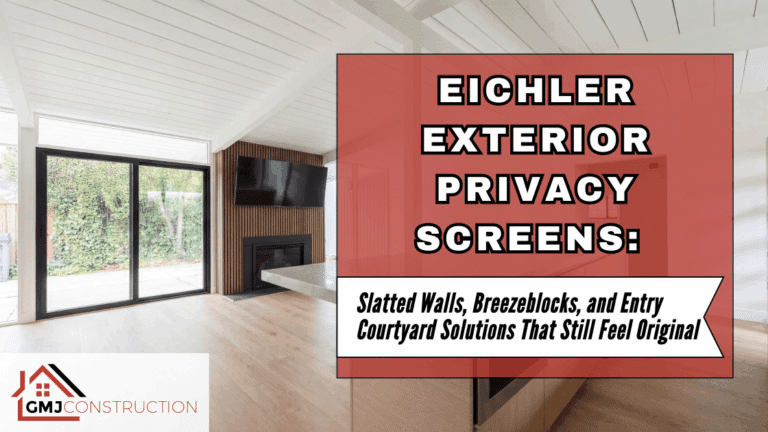
An Eichler exterior privacy screen should protect the spaces where you live without making the property feel closed, heavy, or disconnected from its architecture.
The most successful designs preserve openness, repeat lines already present on the house, and treat the screen as a transitional architectural element rather than a conventional suburban fence. Slatted wood walls, breezeblocks, partial solid panels, and layered landscaping can all work when their placement responds to actual sightlines.
Material selection matters, but proportion, alignment, spacing, and the view from inside the home are equally important. National Register documentation for San José Eichler tracts identifies open planning and integrated outdoor spaces among the defining qualities of these homes. A thoughtful Eichler home renovation should strengthen that relationship while providing the level of privacy your household needs.
Why Privacy Screens Require a Different Approach on an Eichler Home
Eichler-compatible privacy design rests on three principles: preserve openness, repeat existing architectural lines, and integrate the screen into the path between the street, courtyard, garden, and interior.
A tall stockade fence may block views, but it can also compete with the home’s low roofline and understated street presence. A better solution often filters the specific unwanted view while allowing light, air, landscaping, and visual depth to remain. Before changing the exterior, review the broader principles involved in renovating an Eichler home so the privacy feature supports the entire property.
Privacy Without Eliminating Eichler Openness
Complete visual enclosure is rarely necessary around every part of an Eichler. Instead, privacy can be layered through:
- Closely spaced slats near exposed windows
- Wider slats beside landscaped areas
- Partial breezeblock walls at courtyard boundaries
- Carefully positioned solid panels near bedrooms
- Trees and sculptural planting behind architectural screens
This approach protects direct sightlines without turning large windows, atriums, or side passages into dark, confined spaces.
What Makes a New Screen Feel Original
A screen feels connected to an Eichler when it uses simple geometry, restrained materials, and proportions found elsewhere on the house. Horizontal slats may reinforce fascia lines and low roof forms, while vertical slats may respond to grooved siding, entry gates, or existing posts.
The National Park Service rehabilitation standards provide a useful preservation principle: new work can be compatible in size, scale, proportion, and materials without pretending to be an undocumented original feature. That distinction helps homeowners avoid one of the most common Eichler remodeling mistakes, adding a highly visible feature that looks themed rather than integrated.
Start With Sightlines, Not Screen Materials
Before choosing redwood, cedar, concrete block, or metal, identify exactly where privacy is missing. A screen should solve a defined visual problem rather than surround an area simply because space is available.
Use this four-step assessment:
1. Identify the Unwanted View
Stand at the sidewalk, driveway, neighboring property line, and entry approach. Determine whether exposure comes from pedestrians, parked vehicles, neighboring windows, or guests approaching the door.
For example, a living-room window may only be exposed from one short section of sidewalk. A targeted panel placed between that viewing angle and the glass can provide more privacy than a continuous front-yard wall.
2. Protect Important Interior Sightlines
Evaluate the exterior from inside the home. Sit where you normally sit in the living room, dining area, bedroom, or atrium and note what remains visible.
Floor-to-ceiling glass changes the privacy calculation because a screen becomes part of the interior view. It should frame landscaping or create a calm architectural backdrop rather than resemble the unfinished back of a fence.
3. Preserve Daylight, Airflow, and Garden Views
Use filtered screening when complete opacity is unnecessary. Wider gaps may work beside a garden, while direct street exposure may require closer spacing, angled slats, or overlapping panels.
Check the effect during both daytime and evening conditions. At night, an illuminated interior can become more visible from outside even when daytime exposure appears limited.
4. Align the Screen With the Architecture
Align the screen top with a fascia board, window head, gate, beam, siding joint, or adjacent wall whenever practical. Avoid arbitrary heights and isolated panels that appear unrelated to the house.
This same discipline applies to other Eichler curb appeal improvements, where a few coordinated details often create a stronger result than numerous decorative additions.
Slatted Wood Walls for Warm, Adjustable Privacy
Slatted wood walls are well suited to Eichler exteriors because they add warmth and visual rhythm without requiring a fully opaque barrier. Their effectiveness depends on orientation, spacing, material, finish, and structural detailing.
Horizontal Versus Vertical Slats
Horizontal slats emphasize long elevations and low rooflines. They often work well along front courtyards, side yards, and boundaries between a carport and entry.
Vertical slats can complement vertical siding grooves, narrow entry gates, or repeated post spacing. They can also make a compact courtyard feel taller. In either orientation, avoid ornate lattice, scalloped boards, decorative caps, or traditional picket profiles.
Choose Slat Spacing Based on the Privacy Goal
Slat spacing should respond to the viewing angle:
- Close spacing: Best for direct sidewalk or neighboring-window exposure
- Moderate spacing: Provides privacy while retaining light and airflow
- Wide spacing: Works as a visual divider rather than a privacy barrier
- Angled or offset slats: Block views from one direction while remaining open from another
Test visibility from seated and standing positions before finalizing the layout. A mock-up using several full-size boards is more reliable than judging spacing from a small material sample.
Select Wood and Finishes That Complement the House
Redwood, cedar, thermally modified wood, and selected durable alternatives can create different appearances and maintenance requirements. Coordinate the screen with existing siding, fascia, beams, gates, and the front door rather than introducing several competing wood tones.
Review the benefits and drawbacks of redwood siding when considering a related wood species or finish. Proper ground clearance, drainage, sealed end grain, appropriate fasteners, and planned maintenance are important for any exposed wood assembly. A natural finish may emphasize grain, while a painted or stained finish can connect the screen more closely to the home’s established exterior paint and stain system.
Make the Screen Look Architecturally Supported
Use clean posts, consistent module widths, restrained connections, and fasteners that do not dominate the finished surface. Posts should appear intentionally located rather than added wherever a standard fence panel happened to end.
Where appropriate, integrate the screen with a planter, entry gate, carport post, or courtyard wall. The goal is a built-in composition, not a row of unrelated fencing components.
Breezeblock Walls That Filter Views, Light, and Air
Breezeblocks can provide privacy, shadow, airflow, and geometric interest, but they should be used selectively. On an Eichler, the strongest applications are usually entry courts, carport dividers, patio screens, and short garden walls.
Where Breezeblocks Work Best
Consider breezeblocks for:
- A partial entry courtyard boundary
- A transition between a carport and garden
- A patio or poolside screen
- A low wall beside an entry path
- A partial wall terminating at an existing structural element
A limited installation often feels more authentic than wrapping the entire property in patterned block.
Choose a Pattern That Supports the Architecture
Favor simple geometric patterns with a visual density appropriate to the privacy goal. Look at the pattern from both sides and consider how sunlight will cast shadows through it throughout the day.
Use one repeated block style rather than mixing several motifs. Too many patterns can turn a quiet exterior into an exaggerated mid-century theme.
Keep the Wall Proportionate
Test partial-height walls before assuming a full-height enclosure is needed. The top of the wall may align with a gate, window head, beam, or adjacent solid panel.
Breezeblock should remain part of a limited material palette. Pairing it with simple wood, concrete paving, existing siding colors, and restrained planting usually produces a more cohesive result.
Plan for Structure, Drainage, and Long-Term Durability
Decorative concrete screen blocks should not be treated as casually stacked landscape materials. Freestanding walls may require an appropriate footing, reinforcement, structural framing, drainage planning, and engineering based on wall dimensions, soil conditions, and wind exposure.
Complete the structural plan before selecting the final pattern because block shape and open area may affect how the wall can be reinforced and supported.
Entry Courtyard Screens That Create a Layered Arrival
An effective Eichler courtyard entry combines four elements: a defined threshold, a filtered view, a clear path, and a restrained material palette. The screen should make the arrival feel intentional without revealing every private space from the sidewalk.
Use the Gate as an Architectural Focal Point
Keep the gate flat, simple, and visually connected to the adjacent screen. Its height and width should relate to the entry path and surrounding architectural lines.
The gate can blend into a slatted wall or provide one controlled accent through color or hardware. Avoid arched tops, ornate ironwork, oversized posts, and traditional fence hardware that conflicts with the house.
Reveal the Courtyard Gradually
Slats and breezeblocks can provide partial views of a specimen plant, textured wall, or paved path while concealing windows and seating areas. This creates depth between the sidewalk, gate, courtyard, and front door.
Place openings intentionally so a visitor sees landscaping first, not directly into a bedroom or living space.
Combine Hardscape and Landscaping
Pair architectural screens with low planters, gravel, concrete paving, simple groundcover, and sculptural plants. The Eichler home landscaping guide offers additional direction for supporting the home’s indoor-outdoor character.
Vegetation can soften a screen, but it should not be the only source of immediate privacy or completely obscure the architecture.
Integrate Lighting, Address Numbers, and Hardware
Use restrained fixtures that illuminate the path, latch, and house numbers without producing glare through open patterns. Coordinate gate pulls, hinges, mailboxes, and access controls with the exterior material palette.
House numbers should remain visible from the street and emergency approach. Review the practical options for placing house numbers on an Eichler before the screen layout is finalized.
Coordinate Privacy Screens With Eichler Materials and Proportions
Five Details That Make a Privacy Screen Feel Built In
- Align its height with an existing beam, window, fascia, gate, or wall.
- Repeat module widths found in posts, siding grooves, or window bays.
- Limit the design to a small family of compatible materials.
- Coordinate the finish with the home in direct sun, shade, and evening light.
- Detail both sides because the screen will be seen from the house and the street.
Repeat Existing Lines and Module Widths
Random panel widths and uneven post spacing quickly make a screen look improvised. Use a consistent module that responds to the home’s structural or visual rhythm.
Limit the Material and Color Palette
Select wood, concrete, metal, and paint colors that already exist on the house or clearly complement them. Use contrast intentionally. Material samples should be viewed outdoors because sunlight and shade can alter color significantly.
Distinguish Restoration From Compatible New Design
Do not describe a new breezeblock wall or slatted screen as original unless plans, photographs, or surviving evidence support that claim. A new feature can still be period-sensitive and architecturally compatible without creating a false historical replica.
Check Permits, Setbacks, Neighborhood Rules, and Utilities
Permit and fence requirements vary by city, zoning district, lot configuration, wall height, location, and construction type. A screen that is allowed in a rear or interior side yard may face different restrictions near a front property line, driveway, intersection, or corner lot.
Confirm Requirements Before Ordering Materials
Your pre-construction checklist should include:
- Local fence and wall height limits
- Front, side, and rear setback rules
- Corner-lot and driveway visibility requirements
- Planning, building, or architectural review
- Structural design for masonry screens
- HOA, neighborhood association, or historic district standards
- Easements, drainage routes, and underground utilities
- Existing radiant-heating or site systems that could be affected by excavation
Bay Area requirements are not uniform, even between nearby communities such as Palo Alto and San José. Confirm the current rules for the specific property before ordering blocks, fabricating gates, or digging post holes.
Plan an Eichler Privacy Screen That Looks Built In, Not Added On
Before Construction Begins
- Photograph the exposed sightlines from inside and outside the home.
- Document the house’s existing materials, dimensions, colors, and architectural lines.
- Review the concept with a contractor familiar with Eichler construction, exterior detailing, drainage, structural coordination, and local permitting.
The right privacy solution should make your home more comfortable while preserving the openness and quiet geometry that make it distinctive. GMJ Construction can help you plan and build a slatted screen, breezeblock wall, entry gate, or complete courtyard privacy design that feels connected to the home rather than added after the fact.