
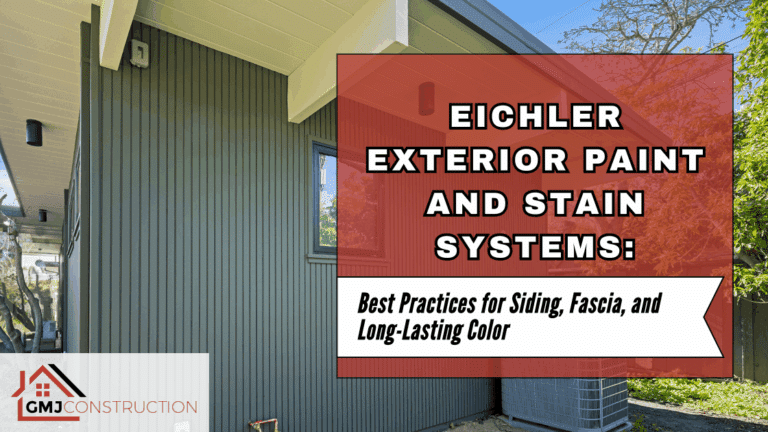
An Eichler exterior should feel calm, architectural, and connected to the landscape, but getting that look takes more than choosing a beautiful color.
Because Eichler homes rely on wood siding, exposed fascia, simple rooflines, and carefully placed accent colors, the finish must protect the materials while preserving the original design language.
The best approach starts with understanding the home’s siding condition, prior coatings, moisture exposure, and architectural details before selecting paint or stain.
Homeowners can also consult resources such as the Palo Alto Eichler Neighborhood Design Guidelines to better understand why muted body colors and restrained accents often work so well.
If you are planning a broader update, GMJ Construction can help connect exterior finish choices with a more complete whole-home Eichler renovation plan. With the right system, your Eichler can look crisp, authentic, and well-protected for years.
Why Eichler Exterior Paint and Stain Systems Need a Different Plan
An Eichler exterior paint and stain system is the complete plan for preparing, sealing, priming, coloring, and protecting the home’s siding, fascia, trim, and exposed architectural details. It is not just a paint color. It is a coordinated finish strategy that supports the home’s design and protects aging wood.
A strong plan considers:
- Substrate: Eichler wood siding, fascia boards, grooves, trim, and beam ends all absorb and release moisture differently.
- Exposure: Sun, fog, rain splash, shaded walls, roof runoff, and tree debris can affect each side of the home differently.
- Design intent: Eichler exteriors traditionally work best with grounded body colors, clean fascia lines, and small, intentional accent moments.
This is why an Eichler should not be approached like a standard wood-sided house. The broad rooflines, vertical siding patterns, exposed fascia, and simplified forms all work together visually. A heavy-handed color scheme can flatten that architecture, while the wrong coating can trap moisture, peel prematurely, or highlight old repairs.
The coating system matters more than the color alone. As the USDA Forest Products Laboratory explains in its guidance on finishing wood, exterior finishes are not only about appearance. They help protect wood from water, sunlight, and weathering. For Eichler homes, that means primer, sealer, stain, paint, sheen, surface prep, and application method should all be selected as one compatible system.
Paint vs. Stain for Eichler Siding: How to Choose the Right Finish
The right finish depends on your siding’s current condition, what has been applied before, and how much of the original wood character you want to preserve. In many cases, the best choice is not the most “authentic” finish in theory, but the finish that will perform best on the actual siding you have today.
| Finish Type | Best Use | Pros | Limitations | Maintenance Expectation |
| Paint | Previously painted siding, damaged siding, major color changes | Strong coverage, consistent color, good protection | Can peel if prep is poor or moisture is trapped | Inspect annually and touch up failure points early |
| Solid stain | Wood siding that needs coverage but should still feel wood-forward | Softer look than paint, good color control, often less plastic-looking | Requires compatible existing surface | Maintenance depends on exposure and prep quality |
| Semi-transparent stain | Clean, consistent, bare wood in good condition | Shows wood grain and texture | Risky on weathered, patched, or previously coated siding | Requires closer monitoring and more consistent substrate |
| Specialty coating | Specific problem areas or unique substrates | Can solve targeted performance issues | Must be chosen carefully for compatibility | Follow manufacturer guidance closely |
Paint usually makes sense when the siding has already been painted, when repairs need to be visually unified, or when the homeowner wants strong color consistency. It can also help protect older siding when paired with proper prep and primer. However, paint is less forgiving when moisture gets behind it, especially around grooves, fasteners, and unsealed edges.
Solid stain can be a smart middle ground for Eichler siding because it gives more coverage than semi-transparent stain while still feeling less heavy than a traditional paint film. It works especially well when the goal is a restrained, modern exterior with a wood-conscious feel.
Semi-transparent stain is the riskiest option on many older Eichlers. If the wood is uneven, patched, sunburned, previously coated, or weathered in different areas, the stain can absorb inconsistently. The result may look blotchy rather than intentional. Before choosing a semi-transparent finish, the siding should be inspected carefully to confirm that the wood is clean, consistent, and suitable for that type of system.
Start With Siding Condition Before Selecting a Product
Before you pick an Eichler exterior paint or stain, start with the condition of the siding. Product choice should follow the inspection, not lead it. A premium coating cannot make soft fascia, open joints, peeling grooves, or moisture-damaged siding perform like new.
Use this inspection checklist before repainting or staining:
- Coating failure: Look for peeling, flaking, blistering, chalking, and worn areas.
- Moisture exposure: Check lower siding, shaded elevations, roof runoff areas, and walls near landscaping.
- Rot or softness: Press gently around fascia boards, trim ends, and lower panels to identify soft wood.
- Edge condition: Inspect cut ends, grooves, panel edges, and exposed end grain.
- Fasteners: Look for rust staining, popped nails, or fastener holes that may let moisture in.
- Prior repairs: Identify patched siding or mismatched panels that may absorb coatings differently.
- Adhesion: Test whether the existing coating is still bonded well enough to receive another system.
Peeling paint on Eichler siding often points to a bigger issue than age alone. It may signal trapped moisture, poor surface prep, incompatible coatings, or deteriorated wood. If the siding is sound, sanding, scraping, spot-priming, sealing, and repainting may be enough. If panels are swollen, delaminated, rotten, or repeatedly failing, replacement may be the more durable solution.
Edges deserve special attention. Cut ends, nail holes, joints, vertical grooves, and transitions between siding and trim are common failure points. Sealing these areas before the topcoat is one of the simplest ways to improve long-term performance.
Prep Work, Fascia Protection, and Color Choices That Last
Prep determines how long an exterior finish will last. Brand and color matter, but they cannot overcome a rushed surface. For Eichler homes, prep should be detailed because the architecture exposes so many edges, seams, grooves, and horizontal lines.
A reliable process usually looks like this:
- Clean dirt, oxidation, mildew, chalking, and debris.
- Scrape loose or failing paint.
- Sand rough transitions and feather peeling edges.
- Repair damaged siding, trim, fascia, caulk joints, and fastener holes.
- Dry the surface fully before coating.
- Prime bare wood, repairs, exposed edges, and patched areas.
- Seal joints, cut ends, and vulnerable transitions.
- Topcoat at the proper spread rate and dry film thickness.
Fascia, trim, and beam ends often need extra protection because they take more exposure than the main siding. Roofline edges can collect runoff. Beam ends can absorb moisture. Trim seams can open with movement. Gutters, shade, and tree debris can also create damp areas that cause finishes to fail faster.
Pay special attention to these failure points:
- Fascia edges and roofline joints
- Beam ends and exposed wood ends
- Trim seams and panel transitions
- Lower siding near grade or landscaping
- Areas under gutters, downspouts, and roof runoff
- Shaded walls with mildew or persistent dampness
Color should also be chosen with performance and architecture in mind. Eichler paint colors tend to age best when the body color feels grounded in the landscape. Taupe, charcoal, brown, gray-green, clay, and warm neutral tones often support the home’s mid-century form without competing with it. Fascia and trim can be darker or cleaner in contrast, but the palette should stay controlled.
Use accent colors sparingly. A front door, entry panel, or small architectural feature can handle a stronger color more gracefully than a full elevation. Before making a final choice, test large sample boards in Bay Area light. Fog, shade, tree cover, western exposure, and reflected light from an atrium can all change how the same color reads throughout the day.
Bay Area Conditions, Lead-Safe Prep, and Long-Term Maintenance
Bay Area Eichler exterior painting comes with local conditions that affect both product selection and maintenance. A Peninsula Eichler under tree shade may deal with more mildew and dampness, while a San Jose Eichler may face stronger sun and heat exposure. Coastal influence, fog, rain splash, inland heat, and neighborhood context can all affect how long a coating lasts and how a color ages.
Local conditions to plan for include:
- Morning fog and shaded siding that stay damp longer
- Sun-facing walls where darker colors may fade faster
- Tree debris that traps moisture along rooflines and trim
- Rain splash near lower siding and landscaping
- Microclimates that vary from neighborhood to neighborhood
- California and Bay Area coating rules that affect product availability and VOC compliance
Older Eichler homes also deserve a lead-safe approach. Many were built before 1978, so aggressive sanding, scraping, or dust-producing prep should not begin until the risk of lead-based paint has been considered. The EPA’s Lead Renovation, Repair and Painting Program explains requirements for paid renovation work that disturbs painted surfaces in pre-1978 homes. This is one reason it is important to work with contractors who understand older-home coating risks, containment, surface testing, and safe preparation methods.
After the project is complete, maintenance keeps the exterior looking sharp. Walk the home at least once a year and after major storms. Check fascia, beam ends, lower siding, shaded elevations, caulk joints, and any area where water hits the exterior repeatedly. Clean mildew early, touch up small failures before they spread, and keep a record of the color codes, sheen, primer, stain, batch numbers, and application date.
Plan Your Eichler Exterior Finish With a Specialist
If your Eichler siding, fascia, or exterior color needs more than a basic repaint, the best next step is a full exterior assessment. GMJ Construction can help evaluate siding condition, identify repair needs, choose a compatible paint or stain system, and protect the architectural character that makes your Eichler special.
The goal is not simply to refresh the exterior. It is to create a finish plan that works with the home’s materials, rooflines, color history, and Bay Area exposure. Whether you are repairing fascia, repainting siding, restoring a more authentic palette, or planning a larger Eichler renovation, a careful approach will help your home look intentional rather than overworked.
A lasting Eichler exterior starts with the system, not the color chip. Inspect the siding, repair vulnerable areas, choose paint or stain based on the actual substrate, protect fascia and beam ends, test colors in natural light, and keep up with annual maintenance. When the finish respects both the architecture and the wood beneath it, your Eichler can feel timeless, clean, and beautifully cared for.