
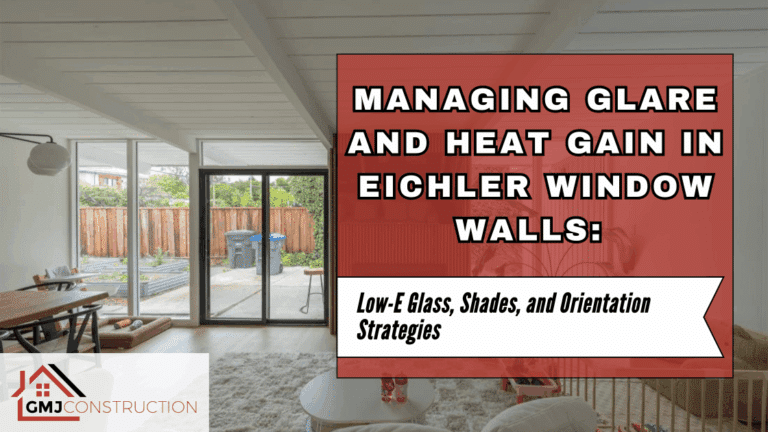
Eichler window walls create the open, light-filled atmosphere that makes these homes distinctive, but the same expanses of glass can also produce glare, overheating, fading, and uncomfortable temperature changes.
The best solution is rarely a single dark tint or heavy window covering. Instead, effective glare and heat control begins with the window wall’s orientation, the condition of its frames and seals, and the way each room is used throughout the day. Homeowners should compare complete-window values using NFRC window performance ratings rather than relying only on glass thickness or marketing terms.
They should also consider how glazing, shading, landscaping, and air sealing work together as part of broader energy-efficient upgrades for Eichler homes. A thoughtful plan can make an Eichler more comfortable without sacrificing clear views, natural daylight, or the indoor-outdoor connection.
Why Eichler Window Walls Create Unique Glare and Heat Challenges
Eichler window walls are more vulnerable to glare and solar heat gain than conventional windows because they place a much larger glass surface between the living area and the sun. Direct radiation can enter across an entire room, warming floors and furnishings while creating reflections on screens and other polished surfaces.
The architectural purpose of Eichler window walls
Floor-to-ceiling glass was not simply a decorative feature. It connected open living areas with atriums, courtyards, pools, and gardens while bringing daylight deep into the floor plan. Uninterrupted sightlines also helped relatively modest homes feel more expansive.
These qualities remain central to a successful Eichler home renovation. Reducing daylight too aggressively may solve one comfort problem while weakening the architectural experience that made the home appealing in the first place.
Why large glass surfaces amplify discomfort
Original single-pane glass and aging metal frames provide limited resistance to heat transfer. When direct sunlight reaches a large window wall, you may notice:
- Bright reflections on televisions and computer monitors
- Warm zones beside the glass during sunny periods
- Cooler zones near the same wall at night or during winter
- Fading of flooring, artwork, textiles, and furniture
- Uneven temperatures between adjoining parts of an open room
The effect can be noticeable even when outdoor temperatures are moderate because sunlight entering the home becomes radiant heat. Understanding basic passive solar design principles helps explain why the sun’s angle, season, shading, and glass orientation matter as much as the weather forecast.
Evaluate Window Orientation Before Choosing Glass or Shades
Every Eichler window wall should not automatically receive the same glass package or shade. Orientation determines when direct sunlight arrives, how high or low it appears in the sky, and how difficult it will be to block.
| Orientation | Typical sunlight condition | Main comfort concern | Preferred response |
| North | Soft, relatively consistent daylight | Heat loss, air leakage, nighttime discomfort | Low U-factor, air sealing, selective privacy control |
| East | Low-angle morning sun | Morning glare and early heat buildup | Adjustable shades that preserve later daylight |
| South | Greater seasonal variation | Summer heat balanced against useful winter sun | Overhangs, exterior shading, balanced solar-control glass |
| West | Strong low-angle afternoon sun | Severe glare and late-day overheating | Lower-SHGC glass, exterior screens, adjustable interior shades |
North-facing Eichler window walls
North-facing glass typically receives less direct solar exposure. The priorities are often insulation, frame condition, air leakage, and privacy rather than aggressive solar control. Glass with strong insulating performance and good visible transmittance can preserve soft daylight without making the room feel dim.
East-facing Eichler window walls
East-facing walls can create intense morning glare in bedrooms, kitchens, and breakfast areas. Adjustable roller shades are often helpful because they can be lowered during the brightest period and reopened after the sun moves higher.
South-facing Eichler window walls
South-facing glass changes significantly by season. Roof overhangs may block the higher summer sun while allowing lower winter sunlight to enter. Before replacing glass, evaluate whether the existing overhang already provides useful seasonal control and whether additional exterior shading would improve it.
West-facing Eichler window walls
West-facing glass is commonly the highest priority for solar control. Low afternoon sun can pass beneath roof overhangs and remain intense until sunset. A combination of lower-solar-gain glass and adjustable shading is often more effective than relying on one measure alone.
Choose Low-E Glass Without Making the Home Feel Dark or Reflective
Low-emissivity glass can improve comfort without turning an Eichler window wall into a dark or mirrored surface. Low-E coatings are microscopically thin layers designed to manage radiant heat transfer, solar gain, and daylight transmission. Different coatings offer different balances, which is why product selection should respond to the elevation rather than using one specification everywhere.
What low-E glass does
A properly selected insulated low-E assembly can:
- Reduce unwanted solar heat entering exposed rooms
- Improve comfort while sitting or standing near the glass
- Reduce non-solar heat transfer through the window
- Limit part of the ultraviolet exposure associated with interior fading
- Preserve useful daylight more effectively than heavily tinted glass
Low-E performance should be considered alongside the frame, spacer, seals, installation, and operable sections. Glass-only values do not describe the complete window wall.
Understand the ratings that matter
Before selecting replacement glazing, compare these four values:
- Solar heat gain coefficient: The proportion of solar radiation admitted through the complete window. A lower number means less solar heat enters.
- U-factor: The rate at which the window assembly transfers non-solar heat. A lower number indicates better insulating performance.
- Visible transmittance: The amount of visible daylight passing through the complete product. A higher value generally preserves more natural light.
- Air leakage: The amount of air moving through the window system under test conditions. Lower values indicate a tighter assembly.
Ask for whole-product ratings that include the frame and glass. This is especially important when comparing narrow metal systems with bulkier replacement products.
Match glass performance to orientation
West-facing window walls may justify stronger solar control, while north-facing glass may prioritize insulation and visible light. South-facing glazing often needs a balanced specification that works with existing overhangs. East-facing rooms may need enough glare reduction for morning use without suppressing daylight for the rest of the day.
This elevation-specific approach is one of the practical ways to avoid common Eichler remodeling mistakes.
Avoid overly dark, mirrored, or color-shifting glass
Review full-size samples from both sides of the glass. A small hand sample may not reveal how an entire wall will look at sunrise, midday, and sunset.
Check:
- Interior and exterior reflectivity
- Changes in landscape and skin-tone colors
- Daylight levels under cloudy conditions
- Differences between fixed panes and sliding doors
- Frame depth and sightline thickness
Decide between replacement glass, complete window systems, and applied film
Retaining an existing frame may be possible when it is stable, compatible with the new glazing, and capable of being properly sealed. Full replacement may be more appropriate when frames are corroded, distorted, leaking, or unable to accept an insulated glass unit.
Applied film can provide glare or solar control in selected situations, but it is not equivalent to a new insulated glazing assembly. Confirm that the film is compatible with the existing glass, seals, and written warranties before installation. Homeowners comparing approaches should also review the factors that influence Eichler window-wall replacement cost.
Match Exterior and Interior Shading to the Sun’s Path
Exterior shading and interior treatments solve different parts of the problem. Exterior products intercept sunlight before it reaches the glass, while interior shades provide convenient glare, privacy, and daylight control after light enters the window.
| Treatment | Heat control | Glare control | Privacy | View preservation | Eichler compatibility |
| Exterior solar shade | High | High | Moderate | Good when open | High with discreet detailing |
| Interior roller shade | Moderate | High | Varies by fabric | Good with suitable openness | Very high |
| Cellular shade | Moderate to high | High | High | Limited when closed | Best in selected rooms |
| Drapery | Varies | High | High | Limited when closed | Moderate with restrained design |
Exterior shading for stopping heat before it reaches the glass
Retractable solar screens, appropriately proportioned awnings, pergolas, trellises, and carefully located planting can reduce direct exposure before sunlight strikes the window wall. Exterior elements should be coordinated with the roofline, structural posts, siding, drainage, and outdoor circulation.
Deciduous trees can provide seasonal shade while allowing more sunlight through after leaves fall. Any planting plan should account for mature size, water needs, roots, maintenance, and the home’s existing architecture. GMJ Construction’s Eichler landscaping guide provides additional design considerations.
Interior roller shades for flexible glare control
Minimal roller shades are often well suited to Eichler interiors. Solar-screen fabrics are available with different openness factors. A more open fabric generally preserves the view but provides less glare and solar control. A tighter weave offers stronger control but reduces view-through performance.
Light-filtering fabrics work well in living areas, while blackout materials may be better for bedrooms or media rooms. Recessed housings and compact fascia systems help keep the installation visually quiet.
Cellular shades for insulation and privacy
Cellular shades create insulating air pockets and can be useful in bedrooms or areas where the exterior view is less important. Top-down and bottom-up models allow privacy without covering the entire wall. Side tracks can provide tighter coverage, although the added hardware must be carefully integrated into an Eichler window-wall composition.
Vertical blinds, panel tracks, and drapery
Slim panel tracks can work across wide openings and sliding doors because their vertical movement follows the direction of the door. Heavy, gathered drapery may overpower slender frames and uninterrupted glazing, although lined curtains can remain practical when blackout, acoustics, or privacy is the priority.
Motorized and automated shading
Motorized shades can respond to scheduled periods of glare instead of remaining closed all day. Controls may be coordinated with sunrise, sunset, temperature, or occupancy. During a remodel, wiring and shade pockets should be planned before walls and ceilings are finished, especially where preserving tongue-and-groove ceilings is important.
Preserve Eichler Sightlines, Frames, and Indoor-Outdoor Character
Modern performance should not require bulky profiles or visually dominant window treatments. The strongest designs make new components feel integrated with the original structural rhythm.
Keep frames visually narrow
Compare the visible frame width of each proposed system, not only its energy ratings. Coordinate finishes with beams, posts, siding, and doors. Avoid unnecessarily heavy profiles that divide the glass wall into smaller-looking sections.
Conceal shade hardware
Recessed pockets, ceiling-mounted tracks, and compact fascia systems help shades disappear when open. Align housings and tracks with mullions, ceiling lines, and structural posts whenever possible.
Use neutral materials that support the architecture
Choose low-reflectivity fabrics, simple textures, and colors that relate to the walls, beams, and landscaping. Treatments should remain consistent across connected panes and sliding doors rather than appearing as unrelated accessories.
Protect transparency instead of eliminating daylight
Zone the shades so only the affected panels need to close. Adjustable systems are generally more flexible than permanently dark glass because they allow you to respond to the hour, season, activity, and privacy need.
How to Make Window Treatments Look Eichler-Appropriate
- Preserve narrow frame sightlines.
- Align hardware with mullions and structural lines.
- Use recessed or compact shade housings.
- Select simple, low-reflectivity fabrics.
- Treat connected panes as one composition.
- Keep atrium, courtyard, garden, and pool views open whenever possible.
For additional planning ideas, review the dos and don’ts of Eichler home remodeling and strategies for creating privacy in an open-plan Eichler.
Build a Layered Strategy for Comfort, Privacy, and Energy Performance
The most successful solution often combines glazing, shading, air sealing, landscaping, and daily controls. A premium glass package cannot correct a leaking frame, and an interior shade cannot stop as much solar energy as a properly located exterior treatment.
Start with a room-by-room sunlight assessment
For several clear days:
- Record when glare and overheating begin and end.
- Identify the orientation of each window wall.
- Photograph the sunlight at different times.
- Note overhangs, trees, fences, and neighboring buildings.
- Document privacy and view priorities.
- Inspect frames, seals, doors, and operable panels.
Select improvements in the right order
Use this five-step process:
- Assess each room, elevation, and period of direct exposure.
- Repair deteriorated frames, seals, flashing, and air leaks.
- Shade the most exposed glass from the exterior where practical.
- Glaze with orientation-appropriate whole-window performance.
- Automate adjustable shades around actual patterns of use.
Avoid common Eichler window-wall mistakes
Do not:
- Use one glass specification on every elevation
- Select glass based only on tint or appearance
- Install film without checking compatibility
- Cover an entire wall when only a few panes create glare
- Ignore installation quality and water management
- Choose treatments before checking door, furniture, and walkway clearances
Window-wall improvements should also be coordinated with roof insulation, cooling needs, and other building-envelope work during comprehensive Eichler remodeling services.
Create a Cooler Eichler Without Losing the Glass-Wall Experience
The goal is not to eliminate sunlight. It is to control the hours and elevations where sunlight interferes with comfort, privacy, furnishings, or everyday activities. Before requesting estimates, gather enough information for contractors and window suppliers to evaluate the complete assembly rather than recommending a generic product.
Prepare for a window-wall consultation
Save or print this checklist:
- Photograph glare when it is most severe.
- Identify the direction each window wall faces.
- Gather available information about the existing glass and frames.
- List rooms affected by heat, fading, privacy, or reflections.
- Identify the views that must remain unobstructed.
- Request whole-window ratings and full-size samples.
An Eichler-specific window-wall assessment can help determine whether you need selective repairs, exterior shading, interior shades, replacement glazing, or a layered solution. Homeowners planning Palo Alto Eichler remodeling, as well as projects throughout the Bay Area, should establish the specifications for each elevation before purchasing glass or shade products.
A cooler, more comfortable Eichler does not require hiding its window walls. Start with orientation, repair the existing assembly, block direct sun where practical, compare complete-window ratings, and add adjustable glare control. This layered approach preserves the daylight, transparency, and indoor-outdoor relationship that make Eichler homes unique.