
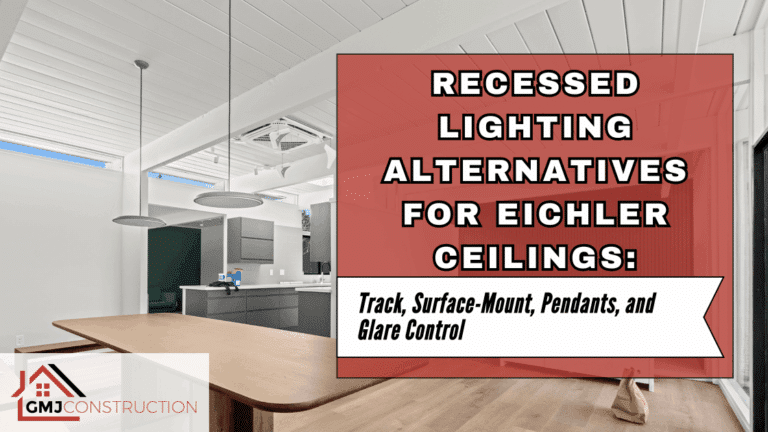
Eichler lighting is not just about making a room brighter. It is about improving comfort while respecting the exposed beams, tongue-and-groove ceilings, glass walls, and open-plan rhythm that make the home feel special in the first place.
In a standard house, recessed lights often disappear into drywall ceilings and attic cavities. In an Eichler, the ceiling is part of the architecture, so every fixture, wire route, and ceiling cut has a bigger visual and construction impact.
A strong lighting plan should support how you live day to day while preserving the clean ceiling plane that gives the home its warmth.
That is why the best approach often combines architectural lighting principles from organizations like the Illuminating Engineering Society with practical remodel planning tailored to the realities of Eichler construction.
Why Recessed Lighting Is Not Always the Right Fit for Eichler Ceilings
Recessed lighting can be difficult in Eichler ceilings because the roof and ceiling assembly is usually much thinner and more exposed than in a conventional home. Instead of a deep attic cavity above drywall, many Eichlers have visible beams, tongue-and-groove wood decking, and a roof assembly directly above the ceiling surface. Cutting into that system can affect the ceiling’s appearance, the electrical layout, insulation coordination, and the roof’s long-term performance.
That does not mean recessed lights are always impossible. It means they should never be treated as the default solution. Before you cut into original wood ceilings, a remodeler should look closely at:
- Beam spacing and ceiling material
- Fixture depth and heat management
- Electrical routing options
- Roof and waterproofing conditions
- The visual effect of multiple ceiling penetrations
Recessed lights can also interrupt the continuous wood ceiling plane that makes an Eichler interior feel calm and connected. A few poorly placed cans can make the ceiling look patched, busy, or overly modern in the wrong way.
If you are planning a larger project, this is the right time to coordinate lighting with your broader whole-home Eichler renovation and addition planning in Palo Alto so lighting, roofing, ceilings, kitchens, and finishes work together instead of being solved separately.
Start With a Layered Eichler Lighting Plan
The best alternative to recessed lighting is not one fixture type. It is a layered lighting plan. In an Eichler, this matters because one source of overhead light can make the room feel flat, while too many visible fixtures can clutter the architecture.
A practical Eichler lighting plan usually includes three layers:
- Ambient lighting: General illumination that makes the room feel comfortable and usable.
- Task lighting: Focused light for cooking, reading, working, grooming, and other daily activities.
- Accent lighting: Light that highlights beams, wood ceilings, plants, art, wall planes, or architectural details.
For example, an Eichler living room might use low-profile track lighting for general illumination, a pendant over the dining table to define the eating area, and soft wall washing around the perimeter to reduce contrast at night. This kind of layered plan gives you flexibility without forcing recessed cans into every ceiling bay.
When selecting color temperature, keep the home’s natural materials in mind. Many Eichler interiors feel best with warm, comfortable light rather than overly cool light. Resources like ENERGY STAR’s light color guidance can help homeowners understand how warmer and cooler light changes the feeling of a room before fixtures are purchased.
Track Lighting for Eichler Homes: Flexible Without Feeling Temporary
Modern track lighting can be one of the strongest recessed lighting alternatives for Eichler ceilings when it is specified carefully. The key is to make it feel architectural, not temporary. Track lighting works best when it is low-profile, clean-lined, aligned with beams or major sightlines, and fitted with small adjustable heads that can aim light where it is actually needed.
For an Eichler, track placement should follow the home’s structure. A track that runs parallel with beams or aligns with a kitchen work zone usually feels more intentional than one floating randomly across the ceiling. The goal is not to hide every fixture. The goal is to make the fixtures feel like they belong.
Track lighting is especially useful in:
- Kitchens: Adjustable heads can light counters, islands, sinks, and cooking zones without relying on recessed cans.
- Hallways: A slim track can provide even light along a circulation path while respecting the ceiling line.
- Living areas: Track heads can aim toward walls, art, plants, or seating areas instead of shining directly into your eyes.
- Multi-use rooms: Adjustable heads allow the lighting to change as furniture layouts change.
For the most Eichler-friendly look, choose smaller heads, simple finishes, warm color temperatures, and dimmable systems. Avoid oversized track heads that make the ceiling feel commercial or gallery-like unless that is the specific design direction you want.
Surface-Mount Fixtures That Respect Eichler Ceiling Lines
Surface-mounted fixtures can provide clean overhead light without requiring deep ceiling cuts. This makes them useful for Eichler ceilings where recessed lighting would be visually disruptive or technically complicated. The best options tend to be simple, shallow, and well-spaced.
Good surface-mount options include:
- Low-profile disks: Best for closets, halls, secondary rooms, and areas where quiet general light is needed.
- Linear surface-mounted fixtures: Best for kitchens, corridors, laundry areas, and long rooms where the fixture can echo the home’s beam lines.
- Directional surface mounts: Best for task or accent lighting where you need some of the function of a downlight without cutting into the ceiling.
The most important design move is restraint. Surface-mounted lighting can quickly feel cluttered if too many fixtures are added. Instead of scattering fixtures across the ceiling, group them around real needs: a sink, a counter, a hallway path, a reading chair, or a darker corner.
Low-profile fixtures often work better than ornate or bulky ceiling lights because they keep the ceiling quiet. In Eichler homes, the ceiling already has texture, pattern, and rhythm. The fixture should support that rhythm, not fight it.
Pendant Lighting for Eichler Kitchens, Dining Areas, and Entries
Pendants can be a beautiful part of an Eichler lighting plan because they add task light, visual focus, and mid-century character without overloading the ceiling. They work especially well when they are used in specific zones rather than spread throughout the home.
Pendants are often a strong fit for:
- Kitchen islands and peninsulas: Use pendants to light the work surface, not just to decorate the room.
- Dining tables: A single well-scaled pendant can define the dining area within an open plan.
- Entries: A simple pendant can create a welcoming moment without blocking the home’s openness.
- Reading corners: A pendant can create a cozy pool of light where a floor lamp might clutter the space.
Scale matters. A pendant that is too small can look accidental, while a pendant that is too large can compete with beams, glass walls, and open sightlines. Hanging height also matters, especially around kitchen islands and dining tables. You want the fixture low enough to provide useful light, but not so low that it blocks conversation, views, or the clean horizontal feel of the room.
Be especially careful with glass pendants in glass-walled interiors. Clear glass can create sparkle, but it can also create glare if the bulb is exposed or reflected in nearby windows after dark.
Glare Control Matters More in Glass-Walled Eichler Interiors
An Eichler can feel bright during the day and harsh at night if glare is not planned carefully. Glass walls, polished floors, shiny counters, and exposed ceilings can all reflect light back into the room. That is why glare control should be built into the plan from the beginning.
Use this quick checklist:
- Add dimmers for main lighting zones.
- Separate ambient, task, and accent lights onto different controls.
- Choose warm, comfortable color temperatures where appropriate.
- Aim adjustable lights at surfaces, not directly at seating areas.
- Use wall washing and bounce light to soften contrast.
- Test fixture placement at night, not just during daylight.
Dimmers are especially important because Eichler spaces often serve multiple uses. The same kitchen and living area may need brighter light for cooking, softer light for dinner, and low light for relaxing. Lighting controls from the U.S. Department of Energy’s lighting controls guidance can help homeowners understand how dimmers and zones improve comfort while also reducing unnecessary light output.
The best rule is simple: light the surfaces you want to see, not the eyes of the people using the room.
Fixture Style: Keep It Mid-Century, Not Themed
Eichler lighting should feel connected to the home’s design without turning the space into a staged mid-century set. The strongest fixtures usually have clean shapes, quiet finishes, and proportions that respect the beams, ceilings, and glass.
Choose:
- Slim cylinders
- Low-profile disks
- Simple linear fixtures
- Globe pendants used with restraint
- Black, white, bronze, brass, or warm metal finishes
- Wood accents when they complement the ceiling rather than compete with it
Avoid:
- Heavy farmhouse fixtures
- Ornate chandeliers
- Oversized industrial lights
- Fixtures with too much visible hardware
- Trend-driven pieces that distract from the architecture
Proportion is more important than trendiness. A fixture should feel sized to the beam spacing, ceiling height, room volume, and furniture layout. In an Eichler, the architecture is already doing a lot of visual work. The lighting should make that work easier to appreciate.
Electrical Planning Before You Choose the Fixtures
Before buying fixtures, plan the electrical layout. Eichler lighting decisions should happen early in the remodel process because wiring routes, switch locations, ceiling conditions, roofing work, kitchen layouts, and dimmer compatibility all affect the final result.
A smart pre-installation checklist includes:
- Confirming ceiling and roof assembly conditions
- Mapping fixture locations before finishes are selected
- Deciding which lights belong on separate switches
- Checking dimmer compatibility with selected fixtures
- Reviewing circuit capacity with the electrician
- Coordinating lighting with kitchen, ceiling, and roof work
- Mocking up fixture placement before final installation when possible
Separate controls are especially valuable. You may want track lighting on one dimmer, pendants on another, and accent lighting on a third. This gives you more comfort and makes the space feel more flexible over time.
For safety and code compliance, electrical work should be handled by qualified professionals. In an Eichler, that professional planning matters even more because the home’s exposed structure leaves less room for guesswork.
The Best Eichler Lighting Feels Built Into the Architecture
The smartest Eichler lighting plan does not force recessed cans into a ceiling that was never designed for them. It uses track lighting, surface-mounted fixtures, pendants, dimmers, zones, and glare control together so the home feels brighter, warmer, and more usable without losing its architectural character.
Planning an Eichler remodel? GMJ Construction can help you design lighting that improves comfort, protects the architecture, and works with the realities of exposed Eichler ceilings. Before cutting into original ceilings or buying fixtures one by one, start with a lighting-focused planning conversation that looks at the whole home, not just the next fixture.
For Eichler ceilings, recessed lighting is often less about whether it can be installed and more about whether it should be installed. Track, surface-mount, pendant, and indirect lighting can usually deliver better comfort, cleaner architecture, and fewer construction complications when they are planned as part of a coordinated Eichler remodel.