
Choosing between radiant heat and mini-splits is one of the most common HVAC decisions Eichler owners face, especially once comfort issues, aging systems, or summer heat start pushing the conversation.
If you live in an Eichler, this choice is rarely just about temperature. It is also about preserving clean lines, protecting the slab, managing operating costs, and respecting the architecture that makes the home special in the first place.
The good news is that there is no one-size-fits-all answer, and that is actually what makes a thoughtful solution possible. In many cases, the right move depends on whether your current radiant system is still viable, how much cooling you want, and how visible you are willing to make new equipment. If you are planning a broader remodel, it is wise to consider HVAC early, alongside insulation, glazing, and layout updates, especially when coordinating a larger whole-home Eichler renovation.
Why This Choice Is So Common in Eichlers
Eichlers create a very specific HVAC challenge. You have expansive glass, low rooflines, slab foundations, and an architectural language that leaves little room to hide bulky mechanical systems. That is part of the beauty, but it is also why a standard forced-air retrofit often feels awkward.
Many original Eichlers were designed around slab-based radiant heat, which gave the home a quiet and even warmth without visible ductwork or registers. But decades later, many owners are weighing whether to preserve that system, repair it, or move toward ductless heating and cooling that better fits current comfort expectations. As the U.S. Department of Energy explains in its overview of radiant heating, radiant systems warm people and surfaces directly rather than blowing heated air through ducts. On the cooling side, ENERGY STAR’s ductless heat pump guidance helps explain why mini-splits have become so attractive in homes without existing ductwork.
If you are trying to decide where your own home falls, start with these questions:
- Do you already have a working radiant system?
- Do you need cooling, or just heat?
- Are you concerned about slab leaks or boiler age?
- How much visual impact is acceptable inside your rooms?
- Are you already opening walls or upgrading electrical during a remodel?
Your answers usually point you toward preservation, replacement, or a hybrid approach.
How Radiant Heat Works (and Why It Fails)
Radiant heat is easy to love when it is working well. Instead of blowing hot air, it creates a more stable, gentler heat throughout the room. In an Eichler, that can complement the calm, minimal character of the architecture better than almost any other system.
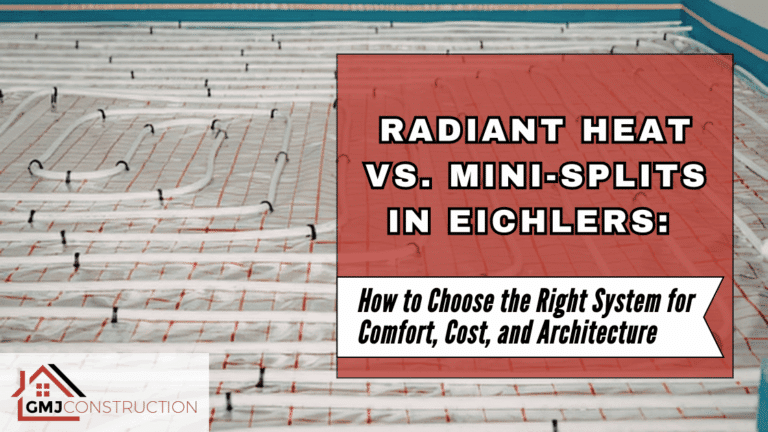
Most Eichler radiant systems rely on tubing embedded in or associated with the slab. Warm water circulates through the system, and the floor mass slowly releases heat into the living space. That slow response is both a strength and a weakness. It can feel comfortable and even, but it also means the system does not react quickly when temperatures swing or when you want rapid control room to room.
Radiant systems also tend to become more complicated with age. Common pain points include:
- slab leaks or corrosion concerns
- outdated boilers or controls
- uneven heating in certain zones
- difficult troubleshooting when parts of the system are buried
- limited flexibility if your household comfort needs have changed
For some homeowners, the biggest issue is not that radiant heat feels bad. It is that repairing hidden components can feel risky compared with installing a newer, more accessible system. If your slab system still performs consistently, that is a very different decision than inheriting one with known leak history or unreliable zones.
How Mini-Splits Work (and Why They Fit Eichlers)
Mini-splits are ductless heat pump systems with an outdoor condenser and one or more indoor units. They heat and cool, which is a major reason Eichler owners gravitate toward them. In practical terms, they solve two problems at once: they add air conditioning and provide flexible heating without requiring full-size duct runs.
That matters in Eichlers because there usually is not a forgiving attic or crawlspace strategy that allows a conventional HVAC system to disappear cleanly. Mini-splits need line sets, power, and condensate routing, but they generally do not demand the same level of invasive ductwork.
They also offer zoning, which can be a strong match for how many people actually live in their homes now. If you work from a back bedroom during the day, host in the great room at night, or want cooler sleeping areas without conditioning the whole house equally, mini-splits let you tailor the system more precisely.
Mini-splits are often a strong fit when you want:
- both heating and cooling in one system
- room-by-room control
- an HVAC retrofit without major duct construction
- better comfort in specific hot rooms
- a solution that can be added in phases
The tradeoff is visibility. Even low-profile heads are still visible unless you move into more concealed or short-ducted designs, which can increase complexity and cost. In a house where every line matters, that is not a small concern.
Comfort Comparison: Heat Feel, Air Movement, and Zoning
This is where the decision becomes personal.
Radiant heat usually wins on warmth quality. It feels calm, quiet, and less drafty. If you love the sensation of stepping onto a temperate floor on a cold morning and do not like air moving around you, radiant has a real advantage. It can also preserve the visual serenity of the home because there are no obvious wall-mounted units.
Mini-splits usually win on responsiveness and control. They can bring a room up or down faster, cool in summer, and let different parts of the house behave differently. That is especially useful if your Eichler has solar gain in certain rooms, sleeping areas that run hot, or occupancy patterns that change through the day.
A simple way to think about comfort is this:
Radiant is best for
- quiet, background warmth
- minimal air movement
- preserving invisible heating distribution
- homeowners who prioritize winter comfort over cooling
Mini-splits are best for
- year-round heating and cooling
- faster response times
- zone-by-zone control
- correcting hot and cold spots more actively
If your biggest complaint is “my house is beautiful but too hot in summer,” mini-splits usually move up the list quickly. If your biggest complaint is “I do not want to ruin the feel of the house,” preserving radiant may still matter a lot.
Cost Comparison: Repairing Radiant vs Installing Mini-Splits
Cost is where many homeowners expect a clean answer, but the truth is that the numbers depend heavily on the starting condition of your home.
Repairing radiant heat can be the more economical move if the system is mostly intact, the boiler is serviceable or replaceable, and you are not chasing extensive slab failures. In that scenario, you may be protecting a system that already suits the house architecturally.
Mini-splits tend to make more financial sense when:
- you need cooling anyway
- radiant repairs are uncertain or recurring
- you want to avoid future slab-related risk
- you are already remodeling and can coordinate installation efficiently
You also want to compare more than first cost. Look at total ownership:
- Upfront cost
Radiant repair might be smaller if the fix is limited. Whole-home mini-split installation can be a larger investment, especially with multiple zones or concealed units. - Future repair risk
Hidden radiant issues can make future repairs harder to predict. Mini-split components are generally more accessible. - Operating flexibility
Mini-splits can reduce wasted conditioning in unused rooms. Radiant systems may be less nimble depending on zoning and controls. - Cooling value
A mini-split system gives you cooling, which changes the value equation significantly in the Bay Area as heat events become more common.
If you are comparing bids, make sure each contractor is pricing the same scope. “Radiant repair” can mean anything from a modest control update to a much deeper corrective project. “Mini-split installation” can also vary dramatically depending on head count, equipment placement, electrical work, and finish expectations.
Architectural Impact: Preserving Ceilings, Glass Lines, and Minimal Visuals
This may be the most Eichler-specific part of the decision.
A technically good system can still be the wrong system if it disrupts what makes the house feel like an Eichler. Wall clutter, awkward soffits, exposed chases in the wrong places, or poorly considered line-set routing can pull attention away from the wood ceilings, glazing, and clean planes that define the home.
That does not mean mini-splits are off the table. It means the design approach matters. Good planning can make the visual impact feel controlled and intentional. In some homes, that means choosing fewer, better-positioned indoor units. In others, it means using concealed ducted mini-split zones in selected spaces where the architecture demands a quieter look.
When reviewing design options, ask your contractor to walk you through:
- indoor head placement from key sightlines
- exterior condenser visibility and noise considerations
- line-set routing before walls are closed
- whether any soffits or chases are truly necessary
- how the system works with lighting, beams, and millwork
If you are already rethinking finishes, glazing, insulation, or layout, it is worth treating HVAC as part of the overall design package rather than a late-stage add-on. That is often where a more cohesive Eichler renovation strategy pays off.
Best Hybrid Approach: Keep Radiant + Add Mini-Splits for Cooling
For many Eichler owners, the smartest answer is not either-or. It is both.
If your radiant heat still works and you genuinely enjoy the comfort it provides, there is a strong argument for keeping it and using mini-splits to handle cooling plus targeted supplemental heating. This hybrid approach often gives you the best balance of architectural preservation and modern comfort.
Why it works:
- radiant continues delivering the quiet winter heat many owners prefer
- mini-splits add the cooling the original home never had
- shoulder-season use can shift to the mini-splits efficiently
- you reduce pressure to abandon a functioning system just because it lacks cooling
This approach is especially attractive when your radiant system is still dependable but your home has become harder to live in during warm spells, smoky periods, or work-from-home days when certain rooms need more active conditioning.
Electrical Planning and Panel Capacity
Before you commit to mini-splits, do not skip the electrical conversation. Even if the equipment itself is a great fit, the installation still has to work with your panel capacity, available breaker space, and broader electrification goals.
This is not just about whether the unit can turn on. It is about whether your home can support the HVAC upgrade cleanly, especially if you are also considering induction, EV charging, or future electric water heating.
Your electrical checklist should include:
- current panel size and condition
- available breaker space
- load calculation, not guesswork
- dedicated circuit requirements
- future electrification plans beyond HVAC
A good contractor should coordinate this early, not after equipment selection. That helps you avoid surprise panel work and makes sure the HVAC design fits the long-term direction of the home.
The “Right” System Balances Comfort, Risk, and Design Integrity
If you are standing in your Eichler trying to choose between radiant heat and mini-splits, the best answer is usually the one that respects how you actually live while protecting the architecture you bought the home for. Radiant heat still offers a uniquely comfortable and visually quiet experience, but it can carry age-related risk and does not solve cooling. Mini-splits offer flexibility, efficiency, and year-round comfort, but they need careful design so the solution feels integrated rather than intrusive. In many homes, a hybrid strategy ends up being the most balanced path. The key is to evaluate the slab, the electrical system, the visual impact, and your real comfort priorities before locking into a bid.
In an Eichler, the best HVAC choice is rarely the cheapest or the trendiest one. It is the system that gives you dependable comfort, manageable long-term risk, and the least disruption to the architecture that makes your home worth caring for in the first place.