
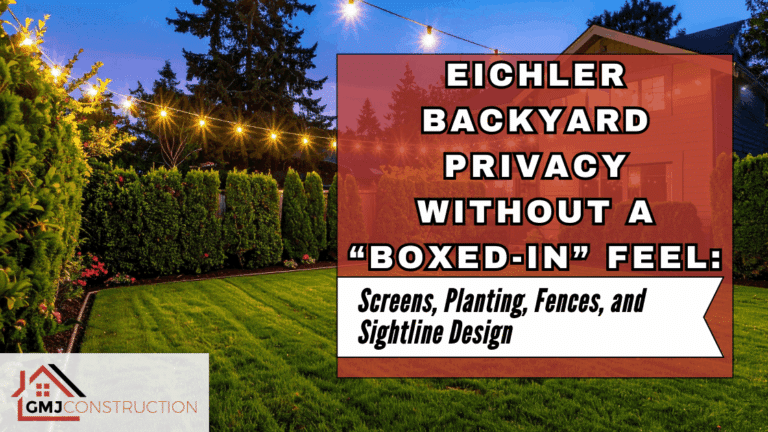
If you live in an Eichler, privacy is never just about blocking a view. It is about preserving what makes the house special in the first place: the glass, the openness, the indoor-outdoor flow, and the calm feeling that comes from seeing structure, landscape, and light work together. That is why the best privacy plan for an Eichler usually starts with restraint, not enclosure. Instead of treating the backyard like a fortress project, it helps to think the way the architecture does, using layers, alignment, and intentional screening to protect comfort without killing openness.
The City of Palo Alto’s Eichler Neighborhood Design Guidelines reflect this same idea by favoring simple fence design, visually penetrable screening, and landscape choices that stay compatible with Eichler character. In practice, that means privacy should feel integrated into the architecture, not pasted on top of it. If you are planning a larger whole-home Eichler renovation in Palo Alto, backyard privacy decisions should be coordinated with glazing, patio layout, lighting, and planting from the beginning rather than treated as an afterthought.
Start With Sightlines: What Needs Blocking and From Where
Before choosing a fence or planting a single shrub, study the actual sightlines. This is where many homeowners save money and get a better design result, because once you identify the real problem angles, you stop overbuilding.
Ask yourself:
- Which views feel exposed from inside the house at seated eye level?
- Which backyard zones are most vulnerable from second-story neighbor windows?
- Where do guests naturally gather at night when privacy matters more?
- Which views should stay open because they add light, depth, or a better connection to the yard?
A targeted screening plan usually works better than a blanket perimeter wall. In many cases, you do not need to block the whole yard. You only need to interrupt a direct line of sight to a dining table, spa zone, lounge area, or major glass wall. That can often be accomplished with a slim screen panel, a pergola edge, a layered planting bed, or a shifted patio arrangement rather than a tall, continuous fence.
This is also where window strategy matters. The U.S. Department of Energy’s guidance on operable window coverings is useful because it reinforces the value of selective privacy control rather than permanent darkness. In an Eichler, that same principle applies outdoors. You want flexible privacy that lets you keep natural light and openness where they help, while softening only the views that make the space feel exposed.
A simple rule is this: block lines, not volume. Once you think that way, the design becomes far more elegant.
Screens That Feel Eichler: Slats, Breeze Block, and Thin Profiles
When a backyard needs more immediate privacy, screens are often the cleanest architectural solution. The key is to choose forms that feel intentional and light.
For Eichlers, the best privacy screens usually share a few traits:
- thin profiles rather than bulky framed walls
- clear rhythm and spacing
- simple materials with minimal ornament
- alignment with the home’s horizontal lines
Horizontal or vertical wood slats can work beautifully when the spacing is carefully tuned. Too open, and the screen does not do enough. Too tight, and it starts to feel defensive. Breeze block can also work in the right setting, especially when you want filtered privacy, shadow play, and a more sculptural mid-century effect. The goal is not just concealment. It is visual texture.
Palo Alto’s Eichler guidelines specifically favor simple, modern fence design and even identify horizontal wood fencing as especially appropriate when it remains visually penetrable. That is an important distinction. You are not trying to make the backyard disappear from the world. You are trying to create enough filtering that the yard feels calm from the inside.
A few practical placements tend to work especially well:
- screening one side of a patio instead of all three
- placing a slatted screen near the house to interrupt views into glass walls
- using a short breeze block wall to define a lounge or dining zone
- pairing a narrow privacy screen with planting so the structure feels softer over time
If you are reworking the entire rear elevation, it often makes sense to design screens together with hardscape and glazing changes so the proportions feel consistent with the house. That is especially true during a whole-home Eichler renovation in Palo Alto, where privacy elements can be integrated into the broader architectural language instead of feeling like add-ons.
Planting for Privacy: Layering Height Without Creating a “Wall”
Planting is often the best answer when you want privacy without the boxed-in feeling. But the right planting strategy is not “put in a hedge and hope for the best.” In an Eichler yard, a single tall hedge can easily become too heavy, too dark, or too suburban in feel.
A better approach is layered planting.
Think in three bands:
- Low foreground planting to soften edges and keep the base of the yard visually open
- Mid-height shrubs to interrupt direct views at the most sensitive zones
- Selective taller material to handle second-story sightlines or neighboring overlook
This layered method gives you privacy while preserving depth and breathing room. It also makes the yard look designed rather than blocked off.
For Bay Area projects, drought-tolerant screening plants are often the smartest long-term choice. Depending on your microclimate and available space, useful screening plants may include:
- coffeeberry for evergreen screening with a softer, more natural look
- Pacific wax myrtle where coastal conditions are favorable
- lemonade berry near the coast where a tougher, drought-tolerant screen is needed
- selected ceanothus varieties when you want evergreen mass with pollinator value
- taller structural trees or large shrubs used sparingly to break upper-level views
The important design move is variation. Let one planting mass rise while another stays lower. Leave deliberate gaps where you want to preserve light or a borrowed view. Use denser material only where the line of sight truly needs interruption. This prevents the common mistake of planting a hard green wall around the entire yard.
When privacy planting is done well, it changes how the yard feels in motion. As you move through the space, views open and close gently, which is much more in tune with Eichler design than a solid perimeter barrier.
Fence Design: Horizontal Lines, Mixed Materials, and Clean Posts
Sometimes a fence is necessary. The trick is making it look like part of the architecture rather than a reaction to the neighbors.
For Eichlers, fence design usually works best when it emphasizes horizontal lines, honest materials, and simple detailing. That might mean horizontal wood boards, a wood-and-metal combination, or a fence with clean posts and shadow reveals that feel crisp rather than bulky. Even a straightforward board fence can look much better when the spacing, top line, and relationship to planting are carefully resolved.
A few design principles help:
- keep the top line simple and consistent
- avoid overly thick caps, decorative lattice, and fussy trim
- let planting soften long runs of fencing
- use material contrast carefully so the fence still reads as quiet background
- coordinate the fence color with the house siding, trim, or landscape palette
It is also worth remembering that privacy fencing is never just a design issue. Height, location, and visibility rules matter. In Palo Alto, standard fence limits vary by location on the lot, and lower limits apply in certain sight-distance areas near streets and driveways. So before locking in a design, verify what is allowed for your specific property and setback condition.
That planning step matters because the most successful fences are not simply the tallest legal option. They are the fences that solve the privacy problem with the least visual weight.
Courtyard and Patio Privacy: Shade Structures and Soft Separation
Backyard privacy in an Eichler is often strongest when it is built around outdoor rooms rather than lot lines. This is especially true for courtyards, atriums, and patios directly adjacent to major glass walls.
Instead of trying to seal off the whole backyard, define the places where privacy matters most:
- the dining zone
- the lounge zone
- the spa or soaking area
- the transition from interior living room to patio
Pergolas, overhead slats, partial roof extensions, and screen-backed seating walls can all create a sense of enclosure without making the yard feel shut down. Soft separation also helps. A raised planter, low wall, built-in bench, or planting pocket can shift how a space feels without creating a visual dead end.
This is often the most “Eichler” way to solve privacy. You create comfort through spatial definition, not through brute-force blocking.
If your patio currently feels exposed, consider whether the problem is actually the lack of a defined edge. Even a modest overhead element combined with one screened side and one planted side can make the space feel far more private while still leaving the yard open beyond it.
Lighting and Night Privacy: Controlling Interior Visibility After Dark
Many privacy problems are not daytime problems at all. They show up at night, when the house glows and the glass turns the interior into a display window.
That is why lighting design belongs in the privacy conversation from day one.
At night, focus on these moves:
- dim the brightest interior zones near large glass walls
- use layered lighting instead of flooding the whole room
- light paths, seating, and entries, not the entire yard
- shield outdoor fixtures so light is directed downward
- avoid bright, exposed bulbs that create glare or spill into neighboring properties
Palo Alto’s Eichler guidelines note that light level at the property line is a key design consideration. DarkSky’s responsible lighting principles push the same idea further: useful, targeted, low-level, controlled, and warm-colored lighting generally performs better than bright, indiscriminate illumination. In plain terms, that means your yard will often feel more private, more comfortable, and more elegant when it is lit less aggressively.
Night privacy is also where selective coverings help. If a living room wall of glass faces a sensitive view corridor, a carefully chosen operable shade or screen gives you flexibility without sacrificing the architecture during the day.
A good rule of thumb is this: if your backyard lighting makes the house brighter to the outside than the garden is to the inside, privacy will suffer.
The Best Privacy Feels Architectural, Not Defensive
The best Eichler backyard privacy plan rarely comes from one move. It comes from several smart, restrained ones working together: targeted sightline control, light screens, layered planting, clean fence design, defined outdoor rooms, and thoughtful night lighting. When those pieces are coordinated well, you get a backyard that feels more private without feeling smaller, darker, or boxed in.
If you are trying to improve privacy in your Eichler, start by asking where comfort is actually breaking down. Once you know that, the right solution is usually more surgical and more elegant than you first expected. In a house defined by openness, privacy works best when it still lets the architecture breathe.
For an Eichler backyard, privacy should feel filtered, layered, and architectural. Focus on blocking the specific sightlines that matter, then use simple screens, well-scaled planting, clean fencing, and low-glare lighting to create comfort without losing the openness that makes the home special.