
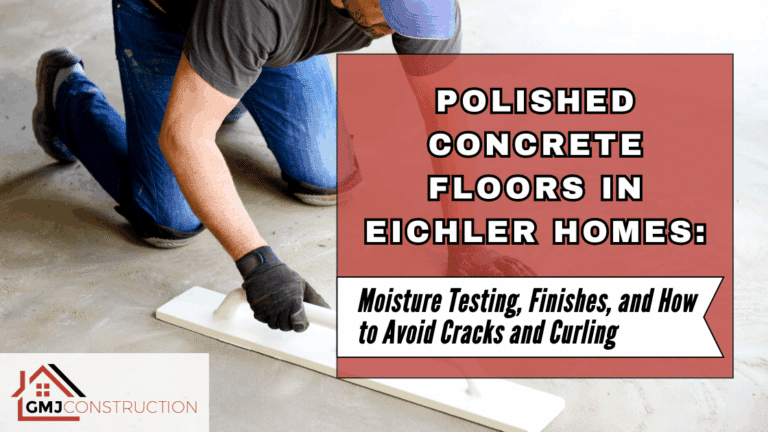
Polished concrete floors in Eichler homes can feel beautifully aligned with the original architecture because they support clean lines, slab continuity, indoor-outdoor connection, and mid-century simplicity. Instead of adding a heavy floor covering, polished concrete lets the home’s structure feel honest, open, and understated.
That said, an Eichler slab is not just a design surface. It may also contain radiant heat, old repairs, adhesive residue, moisture movement, and decades of hidden wear. Before you commit to polishing, it is worth understanding how ASTM concrete moisture testing standards and slab evaluation affect the final result. This guide walks you through the practical decisions that matter most before turning an existing Eichler slab into a finished floor.
Why Polished Concrete Floors Appeal to Eichler Homeowners
Polished concrete floors in Eichler homes work visually because they echo the home’s original design language: simple materials, open plans, glass walls, and a strong connection between interior and exterior spaces. The floor does not compete with the architecture. Instead, it helps the rooms feel calmer, cleaner, and more continuous.
The Eichler Look Depends on Simplicity, Not a Perfectly New Surface
Eichler concrete floors do not need to look brand new to feel right. In many homes, slight variation, softened imperfections, and subtle aggregate exposure can support the mid century character. The goal is usually not a showroom-gloss floor. It is a finish that feels intentional, durable, and compatible with the home’s original rhythm.
The Slab Is Both the Floor and the Foundation of the Finish
In a slab-on-grade Eichler home, the concrete is not just something under the flooring. It becomes the floor itself. That means moisture, cracks, curling, patchwork, and radiant heat conditions all influence the final look. A polished concrete project should begin with evaluation, not finish samples. For larger projects, this is especially important when polished floors are part of a broader whole-home Eichler renovation or addition.
Start With Slab Moisture Testing Before Choosing a Finish
Moisture testing concrete floors is one of the first serious steps before polishing, sealing, staining, or coating an Eichler slab. A slab can look dry on the surface while still transmitting moisture vapor from below. That moisture can affect sealers, stains, coatings, patching materials, and even the long-term clarity of the finish.
A simple pre-finish sequence looks like this:
- Inspect visible slab conditions, including cracks, stains, old adhesive, and patch areas.
- Test slab moisture using appropriate concrete moisture testing methods.
- Compare test results against the actual sealer, densifier, coating, or finish-system limits.
- Choose the finish only after the slab conditions are understood.
Surface Dry Does Not Mean the Slab Is Ready
A surface inspection alone is not enough. ASTM F1869 measures moisture vapor emission from bare concrete floors, while ASTM F2170 is commonly referenced for in-situ relative humidity testing in concrete slabs. These tests help move the decision from guesswork to measurable conditions.
Moisture Testing Helps Avoid Sealer Failure, Cloudiness, and Staining
Moisture problems in polished concrete floors can show up as cloudy sealer, discoloration, staining, bond failure, or inconsistent sheen. The risk is not just cosmetic. A finish that fails early can require additional grinding, stripping, or repair.
Existing Eichler Slabs May Need More Than One Test Area
An Eichler slab may not behave the same way in every room. Atrium-adjacent spaces, additions, bathrooms, kitchens, and former flooring areas may have different histories. Multiple test areas can give a more realistic picture, especially when the slab has visible patching or suspected moisture migration.
How Radiant Heat Changes the Polished Concrete Decision
Polished concrete may be possible over an Eichler radiant heat slab, but only after confirming slab condition, heat-system location, grinding depth, and repair needs. Many Eichler homes were designed with radiant heating associated with the concrete slab, which makes floor preparation more sensitive than in a standard remodel.
Grinding Depth Matters When Heat Lines Are Embedded
Grinding and polishing remove material from the concrete surface. In most projects, the depth may be controlled, but aggressive grinding, trenching, or deep repair work can increase risk if radiant heat lines are embedded in or near the slab. Before heavy prep begins, review any available documentation, look for prior repairs, and consider thermal imaging or specialist evaluation where appropriate.
Heat Can Affect Moisture Movement and Finish Behavior
Radiant heat concrete floors can change how moisture moves through the slab and how finish materials behave over time. Heat cycling may also make certain cracks, patches, or finish inconsistencies more noticeable. This does not automatically rule out polished concrete, but it does mean the contractor should evaluate the slab as a system, not just a surface.
Choosing the Right Polished Concrete Finish for an Eichler Interior
The best polished concrete finish for an Eichler home is usually the one that supports the architecture without overwhelming it. Matte and satin finishes often feel more period-appropriate than highly reflective floors, especially in homes with glass walls, natural wood, globe lights, and open-plan living areas.
| Finish Option | Best For | Watch For |
| Matte polished concrete | A softer, more original Eichler feel | May show stains or variation more naturally |
| Satin concrete finish | Balanced sheen with modern durability | Requires careful sealer selection |
| Higher-gloss polish | More reflective, gallery-like interiors | Can highlight waves, cracks, and patchwork |
| Sealed concrete | Lower-profile finish option | Not the same as true mechanical polishing |
| True mechanical polish | Durable, refined concrete surface | Requires suitable slab conditions |
Matte and Satin Finishes Usually Feel More Eichler-Appropriate
A matte polished concrete or satin concrete finish usually complements mid century modern interiors because it feels calm and understated. It also tends to be more forgiving than a high-gloss surface.
Sealed Concrete vs. Polished Concrete: Know the Difference
Sealed concrete and polished concrete are not identical. Sealed concrete relies more on a topical or penetrating sealer, while true mechanical polishing uses grinding, honing, densifying, and polishing steps to refine the surface. The right option depends on the slab, desired look, maintenance expectations, and budget.
Aggregate Exposure Can Change the Entire Look
Aggregate exposure can make an Eichler polished concrete floor feel more custom, but it can also shift the look dramatically. A deeper grind may reveal more stone, patching, or inconsistencies. Always review a sample area before assuming how the final floor will look.
Cracks Are Not Always a Dealbreaker, But They Need a Plan
Cracked Eichler concrete floors can sometimes still be polished, but the cracks need to be evaluated before work begins. A useful framework is “repair, feature, or avoid.” Some cracks can be stabilized or filled, some become part of the floor’s character, and some may suggest deeper slab movement or settlement concerns.
Cosmetic Cracks, Structural Concerns, and Previous Patchwork
Not all concrete floor cracks mean the same thing. Hairline cracks, random cracks, saw-cut joints, settlement cracks, old trench repairs, and former flooring damage should each be treated differently. The concern is not only whether a crack exists, but whether it is moving, uneven, moisture-related, or tied to a prior repair.
Crack Repair May Improve Performance Without Making the Floor Invisible
Cracked concrete floor repair can improve stability and reduce debris collection, but it may not make the crack disappear. Repair materials can remain visible after polishing, especially when color, porosity, or aggregate exposure differs from the surrounding slab.
The Best Time to Set Expectations Is Before Grinding Starts
Once grinding begins, the floor will reveal more of its history. That is why expectations should be discussed early. Ask what cracks will be filled, what will remain visible, and whether the finished floor is expected to look refined, rustic, or somewhere in between.
What Causes Curling in Concrete Floors and Why It Matters
Concrete curling happens when slab edges or joints lift or distort because the top and bottom of the slab change moisture or temperature differently. Polishing usually does not fix curling. In some cases, it can make unevenness more visible because light reflects differently across high and low areas.
Curling Can Show Up at Edges, Joints, and Room Transitions
Curling may appear near slab edges, control joints, door transitions, room additions, or places where older flooring was removed. In an Eichler, these areas deserve close inspection because the visual continuity of the floor is part of the design goal.
Polishing May Reveal Unevenness Instead of Hiding It
A polished surface can make waves, edges, and transitions easier to see. This is especially true with higher-gloss finishes. If curling or unevenness is present, a matte or satin finish may be more forgiving than a reflective surface.
How to Avoid Moisture, Crack, and Finish Problems Before Work Starts
Before polishing your Eichler concrete floors, ask your contractor for a clear evaluation process. The best projects usually start with testing and mockups, not assumptions.
Use this checklist before committing:
- Ask for concrete moisture testing, not just a visual inspection.
- Review radiant heat concerns before grinding or trenching.
- Identify old adhesive, tile lines, carpet glue, stains, and patchwork.
- Discuss which cracks will be repaired and which may remain visible.
- Request a sample area or finish mockup when the slab has unknowns.
- Compare matte, satin, sealed, and polished options in the actual space.
- Clarify maintenance expectations before selecting the final finish.
Ask for Moisture Testing, Not Just a Visual Inspection
A slab that “looks fine” can still create finish problems later. Moisture testing gives you a better foundation for choosing sealers, densifiers, and coatings.
Review Radiant Heat, Old Flooring Adhesive, and Prior Repairs
Older Eichler slabs often carry a history. Adhesive residue, prior remodels, radiant heat lines, and patch repairs can all affect the final result. These issues should be identified before the finish plan is finalized.
Choose a Finish After Seeing How the Slab Responds
The best finish for polished concrete in mid century homes is often the one that responds well to the actual slab. A mockup can show whether the floor will polish evenly, whether staining is realistic, and whether aggregate exposure supports the look you want.
Work With an Eichler-Savvy Contractor Before Committing to Polished Concrete
Polished concrete can be beautiful in an Eichler, but the right answer depends on moisture, slab condition, radiant heat, finish expectations, and repair planning. This is not a flooring decision to make from a showroom sample alone.
The Best Finish Comes From Testing First, Designing Second
An Eichler-savvy contractor can help you decide whether your existing slab is a good candidate for polishing, sealing, refinishing, or another flooring approach. GMJ Construction understands the design sensitivity and construction complexity that come with Eichler homes, especially when flooring decisions connect to radiant heat, additions, structural work, or whole-home planning. Before choosing a finish, schedule a slab and flooring consultation so the design direction is supported by the actual condition of the home.
Polished concrete floors can preserve the clean, grounded simplicity that makes Eichler homes so special. The key is to treat the slab as both a design feature and a technical system. Test moisture first, evaluate radiant heat carefully, plan for cracks honestly, inspect for curling, and choose the finish only after you understand how the existing concrete will respond.